Sophie, The Wine Insider
Oenologist, troublemaker, your new favourite drinking buddy
Lamb Tagine: Spiced Perfection Meets Rhône Blends
Why Côtes du Rhône reds are the natural partner for Moroccan lamb
Written by
Sophie, The Wine Insider
14 min read
2,667 words
Lamb Tagine: Spiced Perfection Meets Rhône Blends
The Audio Edition
Listen to Sophie & Chad talk about Lamb Tagine: Spiced Perfection Meets Rhône Blends
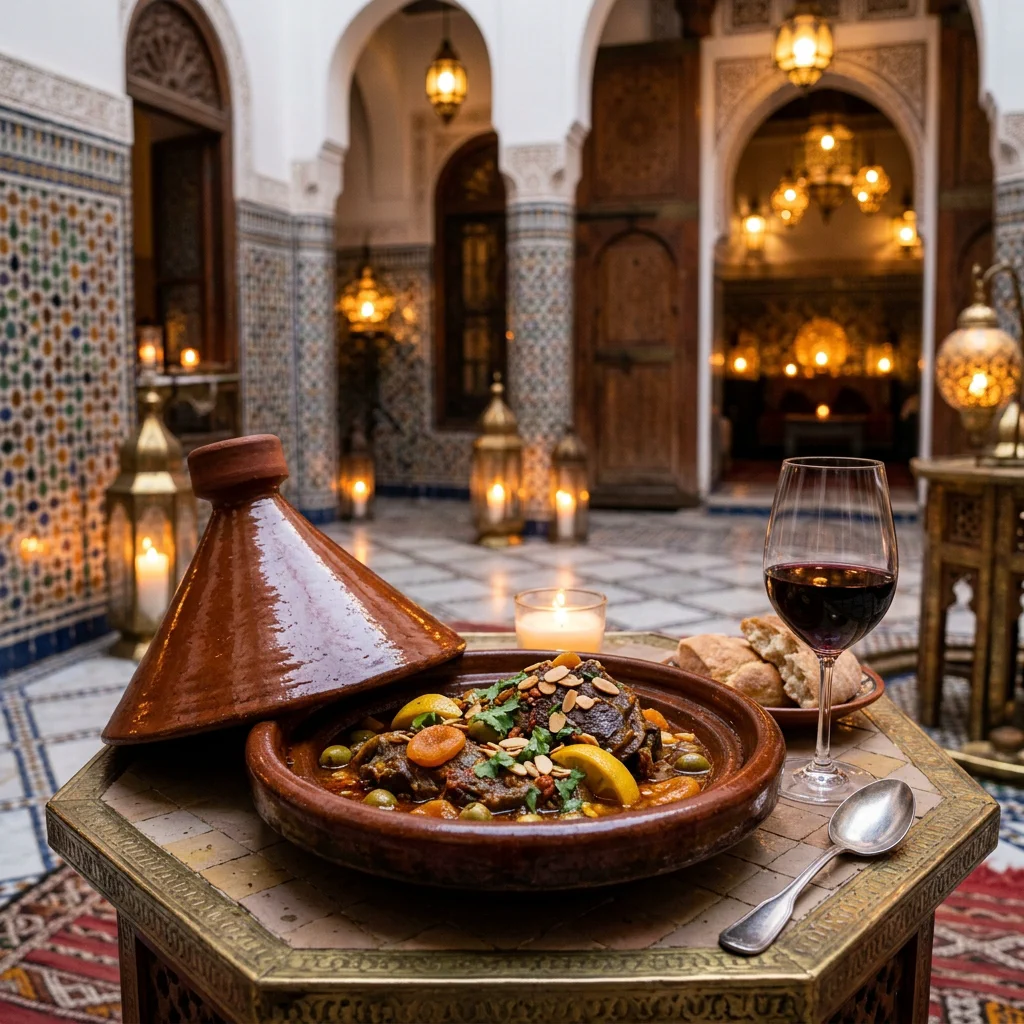
Picture a clay conical pot simmering for four hours on a low flame. Inside: lamb shoulder yielding to fork pressure, jewelled with dried apricots, preserved lemon, cinnamon, cumin, saffron, and a fistful of cracked green olives. The whole production perfumes an entire flat with the kind of ancient-meets-Mediterranean alchemy that made European diplomats of the 19th century lose their minds when they first encountered it in Fez. A Moroccan lamb tagine is one of the great slow-cooked achievements of world cuisine—and it presents a spectacularly interesting wine pairing problem.
The interesting part is that everything conventional wisdom tells you about pairing red wine with lamb (reach for a Bordeaux, drop a serious Malbec on the table, go for big tannic monsters) is exactly wrong here. Tagine isn't plain roasted lamb. It's spice-forward, aromatic, a little bit sweet from the dried fruit, savoury from the preserved lemon, and threaded through with herbs. What you actually want is a wine grown in a landscape that already speaks this language: the sun-baked, herb-strewn hills of the southern Rhône Valley. Specifically, you want a Côtes du Rhône. Tonight I'm putting three of them to work, all of them from the value end of the shelf—and all of them scandalously good for what they cost.
Why Côtes du Rhône Speaks Moroccan
The southern Rhône sits on roughly the same latitude as northern Morocco. The climate is hot, dry, Mediterranean—the sort of landscape where wild thyme, rosemary, lavender, fennel, and juniper grow untended between the vineyard rows. French winemakers have a word for this collective aromatic: garrigue. It translates loosely to 'scrubland' but the real meaning is 'that heady herbal perfume that rolls off sun-warmed hills in July.' When a Côtes du Rhône tastes garrigue-y—and the good ones all do—it's not just a flavour, it's an echo of the landscape itself. And Moroccan lamb tagine, loaded with thyme, cumin, coriander, and bay, speaks the same aromatic dialect. They're cousins separated by the Mediterranean.
The other trick is the grape blend. Most Côtes du Rhône is GSM: Grenache for the juicy red-fruit heart, Syrah for the pepper and savoury depth, and Mourvèdre for the meaty, earthy, slightly-wild kick. That's a trio engineered for exactly this cuisine. Grenache handles the sweet-and-savoury apricot notes, Syrah locks into the cumin and black pepper in the spice rub, and Mourvèdre mirrors the long-cooked, slightly-gamey character of braised lamb shoulder. It's as if someone in the Rhône Valley and someone in Marrakech had the same idea at the same time, a thousand years ago, with no WhatsApp group.
The GSM Formula
GSM blends typically run 50–70% Grenache, 15–30% Syrah, and 5–20% Mourvèdre, with small additions of Cinsault, Carignan, or Counoise depending on the producer. The Grenache brings the alcohol and fruit, Syrah brings colour and structure, Mourvèdre brings the savoury spine. Wines labelled simply Côtes du Rhône come from across the southern Rhône appellation. Wines labelled Côtes du Rhône Villages come from specific higher-quality communes. And Côtes du Rhône Villages + commune name is the top of the regional pyramid. For tagine, any tier works beautifully.
The Three Contenders
Brace yourself, darling—none of these wines costs more than $25. That's not a typo. The southern Rhône is the single most chronically underpriced red-wine region in the world, and if you've been paying $40+ for Napa reds to go with your slow-braised Moroccan lamb, I'm about to save you a great deal of money while simultaneously serving you a better pairing. Each of these three wines brings something slightly different to the tagine table.
1. Saint-Esprit Côtes du Rhône 2023 — The Critics' Darling
If you want to know what a genuine consensus-pick looks like, this is it. Saint-Esprit is from Delas Frères, a well-respected Rhône house, and the 2023 vintage of their basic Côtes du Rhône has scored 91 from James Suckling, 90 from Robert Parker's team, 90 from Wine Spectator, 89 from Decanter, and 88 from Vinous. When five major critics all land within three points of each other on a wine that retails for $14–20, something genuinely interesting is happening in the bottle.
The 2023 vintage in the southern Rhône was warm but balanced—the sort of year that produces approachable, fruit-forward wines with enough structure to carry savoury food. This one is drinking right now through 2028, with no particular reason to cellar it. Uncork, pour, enjoy.
Tasting Profile
The nose opens with ripe red and black fruits—cherry, raspberry, blackberry—mingled with subtle garrigue, a clear note of freshly-cracked black pepper, and a touch of violet. The palate is medium-bodied with cherry, plum, and that signature white-pepper character that Syrah brings to a good GSM blend. Tannins are smooth and well-integrated. There's a herbaceous, slightly wild character that gives the wine real identity—this isn't anonymous bulk wine pretending to be something.
Why It Sings with Tagine
The black pepper and violet notes lock into the cumin-coriander-black pepper spine of the spice rub. The bright cherry and raspberry fruit amplifies the sweet-tart dance of dried apricots in the tagine. And the herbaceous, garrigue character mirrors the thyme and bay simmering in the pot. The medium body is crucial—you want a wine that can stand up to slow-braised lamb without swamping the delicate spice work. Saint-Esprit is exactly that wine.
“When five independent scoring houses—James Suckling, Parker, Wine Spectator, Decanter, and Vinous—all place a sub-$20 wine within three points of each other in the 88–91 range, that's critical consensus. The numbers tell you something honest about the bottle in front of you: this isn't a lucky one-off. Delas Frères are delivering a tier above their price point, year after year.”
Sophie, on why Saint-Esprit is a statistical inevitability
Price-to-Plate
At $14–20, this Côtes du Rhône costs less than the lamb shoulder you're braising inside the tagine. Think about that for a moment. A wine that four different critics rated 90+ points, priced at less than the protein. This is the kind of value that used to exist everywhere in wine and now only really lives in the southern Rhône and a few quiet corners of Spain. Buy by the case.
2. Guy Mousset Côtes du Rhône 2024 — The Garrigue Bomb
Guy Mousset is a family-run domaine based in Châteauneuf-du-Pape, the single most prestigious appellation in the southern Rhône—so their basic Côtes du Rhône bottling carries a little of that Châteauneuf DNA without the Châteauneuf price tag. The 2024 vintage I'm drinking now is youthful, exuberant, and absolutely laden with garrigue character. This is the most herb-forward of the three wines tonight, and it's the one I'd pour first when you want a Côtes du Rhône to announce itself clearly.
Price: $15–25. No formal critic scores (Guy Mousset's classic-tier bottlings often fly under the radar for critic review), but the tasting experience is so consistent year over year that I've bought it by the six-pack for ages. Drinking window: 2026–2030.
Tasting Profile
Aromatically, this is a garrigue explosion: ripe red cherries, blackberries, dried lavender, thyme, smoked meat, and a firm line of black pepper running through the whole thing. Medium-bodied with smooth texture, fine tannins, and a warm, spicy, fruit-driven finish. There's an almost smoky-cured-meat quality on the back palate that I find irresistible. It smells like a walk through Provence in July.
Why It Sings with Tagine
This is the one you pour when the tagine is heavy on the warming spices—cumin, coriander, cinnamon, Ras el Hanout. The smoked-meat note in the wine locks onto the long-braised lamb character, and the lavender + thyme aromatics practically finish the dish for you. If your tagine leans more savoury than sweet, this is the bottle. If it leans sweeter (more apricot, more honey), lean toward Saint-Esprit above instead.
“Guy Mousset's family has been making wine in the Rhône since 1935, and their Châteauneuf-du-Pape bottlings earn serious critical attention. What that means for this entry-level Côtes du Rhône is that the winemaking team knows exactly what they're doing—you're drinking a bottle made by people who also make $60+ wines from a more famous neighbouring appellation.”
Sophie, on the Mousset family pedigree
Price-to-Plate
Mousset's basic Côtes du Rhône lands in the same budget range as Saint-Esprit but offers a noticeably different aromatic experience. Buy one of each for a tasting night and learn the difference between a 'fruit-forward' Rhône and a 'herbal' Rhône. That's a £30 wine education, and it'll upgrade your pairing instincts for life.
3. Fresh & Wild Côtes du Rhône — The Weeknight Tagine Bottle
Some nights you're not cooking a four-hour tagine for a dinner party. Some nights you're reheating leftover tagine on a Tuesday and wondering if you should open a bottle at all. The answer is always yes, and the bottle for that job is Fresh & Wild. This is the absolute budget tier of my Rhône recommendations—$10–18—and it punches miles above its price. It's the 'every Tuesday' bottle in my flat, the one I pour before I've even taken my coat off.
Fresh & Wild is what wine people call a négociant blend—a wine assembled by a merchant house from purchased grapes or finished wine across multiple vineyards. Done poorly, this means bulk plonk. Done well—and it's done well here—it means a consistent, reliable, expressive bottle at a shockingly low price. No vintage pressure, no collector obsession, just a great glass of Rhône red.
Tasting Profile
Aromatically generous: ripe cherry, plum, and blackberry intertwined with lavender, thyme, and a subtle hint of black pepper. Good garrigue character, though less intense than the Mousset above. The palate is mouth-filling and savoury, with nicely rounded tannins and a satisfying length that outlasts its price tag. Deep ruby in the glass. Nothing rough, nothing cheap-tasting, nothing that betrays the $12 shelf price.
Why It Sings with Tagine
This one is the crowd-pleaser. It doesn't demand a specific style of tagine; it just shows up and does its job gracefully. For big family dinners with a variation of lamb, chicken, or vegetable tagines on the table, this is the bottle that works across the board. It won't eclipse the Saint-Esprit or the Mousset in a blind tasting, but for value-per-dollar alongside the food, it's unbeatable.
“Négociant bottlings get a bad rap in wine circles because a lot of the cheap ones are, frankly, forgettable. But when a reputable house sources well and blends with care, you get something like this: an honestly good wine at a price point where most wines are openly bad. It's a reminder that the southern Rhône simply grows too much world-class fruit for all of it to land in expensive bottles.”
Sophie, on the négociant advantage
Price-to-Plate
Ten dollars. Ten dollars. At the bottom of this wine's price range, you're paying less than the preserved lemons and saffron threads you sprinkled into the tagine. If that doesn't move the value needle for you, I don't know what will. Grab a case and pour it freely—this is what weeknight wine should look like.
Sophie's Pick
The Verdict
Three brilliant wines, one unambiguous winner. The Saint-Esprit Côtes du Rhône 2023 is the clear top of the pile here. Four major critics scored it 90+ points, it costs $14–20, and the fruit-plus-pepper-plus-garrigue profile is ideally tuned for a Moroccan lamb tagine with the full spice spectrum. If you want the Mousset for a herb-heavy tagine or the Fresh & Wild for a Tuesday reheat, no arguments here—they're all excellent. But if you can only pull one bottle from the shelf for Saturday's showpiece dinner, pull the Saint-Esprit. Brilliant value, proper pedigree, and a wine that makes the lamb taste better than it has any right to.
And if you're the sort of person who likes to gift-wrap a bottle and bring it to a dinner party where the host is making tagine—which, let's be honest, is the most delightful kind of host—bring the Saint-Esprit. It makes you look like someone who reads Decanter cover-to-cover for fun, and costs roughly the same as a decent bottle of supermarket Prosecco. Très chic, très bon rapport qualité-prix, très you've-done-your-homework. Brilliant all around.
Serving Notes
Sophie's Service Notes
Southern Rhône reds are almost always served too warm. Aim for 58–62°F (about 14–17°C)—fridge the bottle for 20 minutes before opening if your kitchen is at a normal temperature. These wines have a lot of fruit and a decent whack of alcohol (13.5–14.5%), and serving them warm lets the alcohol poke through the aromatics. Fridge-cool, they stay aromatic and refreshing alongside the rich, long-cooked lamb. Decant the Saint-Esprit and Mousset for 15–20 minutes; the Fresh & Wild is fine straight from the bottle. Use Burgundy bowls if you have them (the wide-mouth ones)—they channel the garrigue aromatics beautifully.
- Chill for 20 minutes before serving if the kitchen is at room temperature.
- Decant the Saint-Esprit and Mousset 15–20 minutes before guests arrive.
- Use wide-mouth Burgundy bowls to concentrate the herb and spice aromatics.
- Pour small first pours (4 oz)—the wine opens and changes over 20–30 minutes.
- Drink within a day or two of opening; these aren't wines that age in the fridge.
Building the Tagine Experience
A proper Moroccan lamb tagine is a slow-food affair, and the rest of the meal ought to respect that. Start with something bright and acidic to wake up the palate: a Moroccan carrot salad with cumin and harissa, or a simple plate of tomato-cucumber salad with a sharp vinaigrette. Between courses, bread. Always bread. A round of crusty khobz or a fresh country loaf is the correct tool for mopping up the tagine's rich broth—and you'll want every drop.
Sides That Belong on the Table
- Moroccan carrot salad with cumin, harissa, and olive oil
- Tomato and cucumber salad with parsley, mint, and sharp vinaigrette
- A heap of warm, fluffy couscous (buttered, salted, nothing fancy)
- Crusty khobz or fresh country bread for mopping
- Green harissa on the side for guests who want more heat
- A small bowl of pitted green olives marinated in olive oil and lemon zest
- For dessert: fresh dates, orange slices with cinnamon, and a pot of mint tea
The wine stops being the centre of attention the moment the tagine hits the table—and that's exactly right. Côtes du Rhône is a supporting actor in this production, amplifying everything around it without ever hogging the stage. That's the mark of a great pairing wine: it disappears into the meal, making the whole thing bigger than the sum of its parts.
The Chemistry (Briefly, I Promise)
The wine science here is actually elegant. Lamb—especially slow-braised lamb shoulder—is rich in iron and develops a distinctive savoury-metallic flavour profile during long cooking. Southern Rhône reds, particularly GSM blends, contain small amounts of volatile compounds (rotundone, notably) that the human palate perceives as 'black pepper' even though they're chemically unrelated to actual peppercorns. These rotundone-rich wines have an ancient affinity for lamb because the peppery character triggers the same savoury receptors the lamb is activating. It's flavour-pathway synergy. Then add the garrigue notes—thyme, rosemary, lavender echoed in the glass—and the spice rub in the tagine, and you've got three aromatic layers all shaking hands simultaneously. That's why this pairing feels effortless: the wine isn't just not fighting the food, it's actively building on it.
Rotundone — The Pepper Molecule
Rotundone is the volatile compound responsible for the distinctive black-pepper aroma in Syrah, Durif, and some Pinot Noirs. It was only identified in wine in 2008 by Australian researchers—before that, everyone knew the 'pepper note' existed, but no one knew what caused it. Fun genetic quirk: about 20% of people can't smell rotundone at all. If you've ever had someone tell you they don't get 'pepper' in Syrah, they're not lying—they literally can't perceive the molecule. Wine tasting as a subjective experience isn't just psychology; sometimes it's straight-up genetics.