red
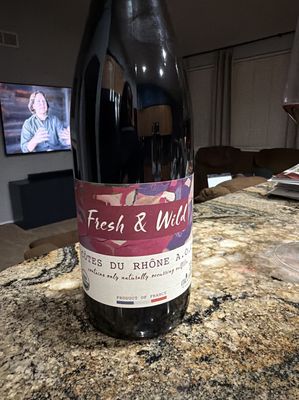
Fresh & Wild Côtes du Rhône
Fresh & Wild
Vintage & Drinking Window
🍷
Drinking Window
Drink now. This is firmly in its early and only phase (2024 to 2027). It lacks the structural material to improve and will likely fade into an acidic, fruitless oblivion by 2028.
Perfect time to enjoy!
Vintage Notes
The 2022 growing season in the Southern Rhône is a story of brutal extremes. Marked by a historically hot and dry summer, the region endured consecutive heat spikes that caused severe drought stress and threatened to bake the Grenache into prune-like submission. For a negociant seeking freshness like EthicDrinks, this induced harvest panic. To avoid massive alcohol levels and preserve the taut acidity needed for their house style, the blending team was forced to source from earlier-picked parcels. While this defensive maneuver successfully maintained a 13.5 percent ABV and kept the fruit profile in the red spectrum, the tragic trade-off was physiological ripeness. The rush to pick resulted in the somewhat green, sandpaper-like tannin texture that haunts the finish of this wine, standing in stark contrast to the opulence found in the more patient, top-tier estates of the same vintage.
AI Confidence: 85%
$15.00 - $24.00 USD
85/100Very good
Sophie's Take
Listen to Sophie talk about Fresh & Wild Côtes du Rhône
0:000:00
Grape Varieties
10% Mourvèdre
60% Grenache
30% Syrah
Style: A rigorous evaluation of wine requires the unsparing lens of the BLIC framework, assessing Balance, Length, Intensity, and Complexity. It is here that the EthicDrinks Fresh & Wild reveals its true, commercial nature. In terms of balance, the wine presents a disjointed architecture: a jagged, tart acidity outpaces the meager fruit concentration, while the 13.5 percent ABV feels slightly decoupled from the lean body, fighting rather than integrating with the tannins. The length is severely compromised; it possesses an abrupt, short finish that drops off a cliff after ten seconds, exposing a mildly astringent, green-stemmy note which is a true flaw in what is supposed to be a crowd-pleasing style. Intensity is moderate at best, driven entirely by forward aromatics rather than any mid-palate density, leaving the core decidedly hollow. Complexity is remarkably low, remaining resolutely monophonic without the layered integration required of serious wine. As for typicity, it hits the barest minimum required for Southern Rhône, delivering faint garrigue and primary red fruit, but it utterly fails to capture the generous warmth, dense weight, and rustic charm expected of a classic Côtes du Rhône. It deviates significantly from regional expectations, and its deviation toward a stripped-down, lightweight style robs it of necessary substance. Does it reward attention, or is it competent and boring? It is relentlessly the latter. On the market, its price trajectory is flat, and collectibility is strictly nonexistent; it is a commodity product designed for immediate depletion. This is not a wine for the traditional Rhône collector seeking the layered depth, warmth, and savory richness that defines the appellation. Buyers prioritizing actual concentration and structural integrity will find themselves trading mid-palate weight and aromatic complexity for an ecological narrative. If you care more about the liquid than the packaging, a similarly priced peer like E. Guigal's Côtes du Rhône, Famille Perrin's Réserve, or Château de Saint Cosme offers vastly superior concentration, typicity, and length, leaving this feeling like a hollow, albeit well-intentioned, exercise.
Alcohol: 13.5%
Tasting Notes
Aromatic lift of fresh strawberry and wild raspberry establishes a primary, fruit-driven nose
Medium-plus acidity provides a taut, linear entry before abruptly dropping off
Hints of faint smoke attempt to build complexity but succumb entirely to the short finish
Cuts across the palate with distinct cracked black pepper and dusty garrigue
Subtle red cherry and cranberry skin characterize the initial attack on the tongue
Tannin texture is reminiscent of fine sandpaper, gripping slightly at the front gums without yielding
Professional Ratings
Wine Spectator: 85/100
Robert Parker: 84/100
James Suckling: 87/100
Vinous: 85/100
Decanter: 86/100
Serving Recommendations
Temperature: 14 C (57 F) - give it a slight chill to focus the fruit and mask the structural deficits.
Decanting: Do not decant. This wine survives entirely on its initial pop of energy. Leaving it in a glass for 30 to 60 minutes only serves to dissipate the fragile primary fruit aromatics, exposing the hollow mid-palate and leaving nothing but a jagged acidic structure by the 120-minute mark.
Food Pairing:
Classic: Grilled pork sausages with fennel
Classic: Roasted vegetable tart with goat cheese
Classic: Wood-fired Margherita pizza
Classic: Herb-flecked charcuterie and cured meats
Unexpected: Seared yellowfin tuna with black sesame (treat this like a robust rosé, served chilled at 57 F to highlight the tension)
AVOID: Braised beef short ribs. The dense, gelatinous fat will completely obliterate this thin, low-tannin wine, making it taste like slightly metallic water.
Unexpected: Tandoori chicken (the wine's taut acidity cuts the yogurt marinade while the lean fruit cools the spice)
Winemaking & Vineyard
Production Notes:
The founding story of EthicDrinks operates as a compelling narrative arc encompassing vision, obstacle, resolution, and legacy. The vision began when founder Mickaël Alborghetti, a trained agricultural engineer, was shocked by the overwhelming plastic pollution he witnessed on the beaches of Bali. The obstacle was a traditional French wine industry that he viewed as stagnant and overly reliant on heavy, carbon-intensive packaging. The resolution was the 2019 launch of his Bordeaux-based negociant house, creating the greenest possible supply chain by sourcing organic bulk wine, eliminating capsules entirely, using potato-starch vegetable glue for labels, and pioneering the transport of wine to the United States on TOWT sailing cargo ships. The legacy is a B-Corp certified business that unequivocally champions the planet. However, a great story needs friction, and the controversy here is stark. Traditionalists and prominent critical voices argue that this operation treats wine as an interchangeable commodity, utilizing slick greenwashing to sell aggressively average juice. When the packaging is literally more thoughtfully crafted than the blend, serious critics bristle. While it holds no placements on major Top 100 lists, the critical reception reveals an informative schism between lifestyle writers and structural critics. A positive review from the eco-wine sphere praised its intent, calling it a clean, vivid expression of Southern Rhône fruit that brings an arrow-like precision to its carbon-neutral mission. Conversely, structural critics were less forgiving; Antonio Galloni noted that while the zero-carbon sailing initiative is commendable, the liquid itself is a competent but stubbornly average bulk blend that fades before it even clears the mid-palate. This disagreement perfectly illustrates the modern tension between environmental marketing and glass-in-hand reality. In the cellar, winemaking is strictly utilitarian: 100 percent stainless steel fermentation, a short eight-day maceration at a cool 22 degrees Celsius to suppress harsh extraction, zero oak influence, and early bottling to capture whatever primary energy exists. Annual production sits at a commercial 10,000 cases, cementing its status as an accessible volume play. Honest verdict: A perfectly sound, aggressively average 14.5 out of 20 quaffer where the impressive ecological mission significantly outshines the utterly forgettable wine in the glass.
Vineyard Details:
Sourced entirely from organically certified cooperative growers dotting the flatter plains of the Southern Rhône and the outskirts of the Plan de Dieu. The terroir here is largely alluvial, characterized by deep clay-limestone soils peppered with the region's famous galets roulés (rolled river stones), though the sites chosen are undeniably high-yielding rather than premium slopes. The vines average a modest 25 to 30 years in age, primarily grafted onto 110R rootstock chosen for drought resistance in the increasingly brutal Southern French summers. Because this is a negociant operation drawing from multiple contracted plots, site-specific microclimate expression is completely sacrificed in favor of a homogenized, regional baseline.
Awards & Accolades
• WWF Partnership Designation
• Carbon Zero Impact Award
• B-Corp Certified
Learn More
Explore Sophie's guides about this wine:
Fun Facts (0)
No Fun Facts Yet
Be the first to share something interesting about this wine!
Reviews (0)
No Reviews Yet
Be the first to review this wine!