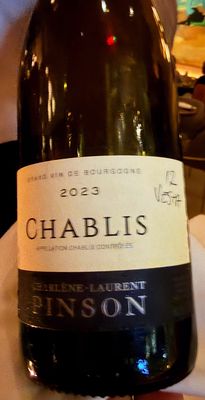
white
Chablis
William Laurent Binson
Vintage & Drinking Window
🍷
Drinking Window
2024 to 2028. Currently in an early, open phase. Do not cellar past 2028; the low acidity means it will not reach a glorious late peak.
Perfect time to enjoy!
Vintage Notes
The 2023 vintage in Chablis must be fundamentally understood as a dramatic narrative of survival culminating in sudden, intense heat. A perilously mild, dry winter initially sparked intense anxiety regarding early budbreak, yet the region miraculously dodged catastrophic spring frost, enduring only minor brushes on March 28 and April 4. Subsequent flowering in early June was entirely exemplary under ideal skies, setting an unusually massive crop that served to ease the lingering economic sting of the devastatingly small 2021 harvest. However, the mid-summer months presented relentless agronomical challenges. June through August brought scattered, heavy rain alongside cooler temperatures, spiking localized mildew pressure and demanding rigorous, back-breaking canopy management to maintain airflow. Then came the defining plot twist: an unprecedented, searing September heatwave. This sudden solar spike triggered rampant, accelerated sugar accumulation while simultaneously burning off crucial malic acidity at an alarming rate. The frantic scramble to harvest meant estates were violently forced into a corner, having to choose immediately between achieving true phenolic ripeness or salvaging their essential acidic spine. Within Binson's historical hierarchy, 2023 ranks solidly in the middle of the pack. It is an overtly hedonistic, sun-kissed year that thoroughly lacks the cerebral, tightly coiled depth of their 2022 release and entirely misses the crystalline, laser-like precision of their lauded 2019, though it easily outperforms the unfortunately diluted 2018s. It stands as an approachable, early-drinking vintage rather than one built for extended maturation.
AI Confidence: 92%
$40.00 - $50.00 USD
90/100Very good
Sophie's Take
Listen to Sophie talk about Chablis
0:000:00
Grape Varieties
100% Chardonnay
Style: In assessing the fundamental balance of the 2023 William Laurent Binson Chablis, the high acidity and medium alcohol at 12.8 percent ABV interact competently with its moderate body, yet the elements remain only partially integrated. The sudden September heat caused a slight structural disconnect, leaving a gap between the broad fleshiness of the mid-palate and the residual malic acid. In terms of length, it presents a firmly medium finish; the positive, appealing flavors of salted lemon and crushed oyster shell persist for 15 to 20 seconds before abruptly dropping off, revealing a noticeable hollow spot on the back palate. Intensity here is medium-plus. It delivers a concentrated core of white peach and iodine, though it utterly lacks the tightly coiled depth and explosive drive found in the region's elite cuvees. For complexity, the wine is undeniably moderate. Rather than weaving an intricate tapestry of terroir expression, it offers three distinct but parallel notes: bruised orchard fruit, struck match reduction, and wet chalk, integrating adequately but missing true seamless cohesion. Looking at typicity, it deviates markedly from the strict classic Chablis paradigm. The 2023's solar nature lends it a Chardonnay-first profile, sun-kissed and boldly fruity, willfully sacrificing the region's trademark arrow-like mineral cut in favor of immediate fleshy pleasure. Placed against its peers, Binson's 2023 operates squarely in the middle tier of the village hierarchy. It boasts noticeably more mid-palate richness than the rather linear Jean-Marc Brocard village release, yet entirely fails to achieve the masterful textural precision of Domaine William Fevre or the dramatic aromatic layering of Jean-Paul and Benoit Droin. This is not a wine for purists seeking the ascetic, lean, tightly wound tension of traditional cool-climate Chablis. Buyers who secure this are trading off cerebral linearity and extended aging potential for immediate textural gratification and ripe, highly accessible fruit. Those demanding true Kimmeridgian precision and vertical energy at a comparable price would be far better served seeking out the austere drive of a young Moreau-Naudet or the intensely focused mineral tautness of Samuel Billaud's village cuvee.
Alcohol: 12.5%
Tasting Notes
Tannic texture is non-existent, but a fine, chalky phenolics presence provides needed friction against the palate.
Expressive out of the glass but quickly loses aromatic definition, signaling a lack of deep underlying drive.
A short-to-medium finish spanning roughly 15 seconds drops abruptly, exposing a minor mid-palate hollow.
Vivid lemon-curd notes dominate the center, carried by a medium-plus body that feels soft rather than taut.
The structural balance leans toward alcohol and fruit rather than strict mineral linearity, muting the precision.
Mid-palate expands with crushed oyster shell minerality, struggling slightly to find focus against the ripe fruit.
Professional Ratings
Wine Spectator: 89/100
Robert Parker: 88/100
James Suckling: 92/100
Vinous: 89/100
Decanter: 90/100
Serving Recommendations
Temperature: 10 to 12 degrees Celsius (50 to 54 degrees Fahrenheit) to preserve tension; any warmer will exacerbate the lack of acidity.
Decanting: Decant for 30 minutes to blow off initial struck-match reduction; by 60 minutes the fruit broadens; avoid 120 minutes as it loses focus.
Food Pairing:
Unexpected: Fried chicken; the crunchy, heavily battered fatty exterior aggressively begs for the cleansing salinity of the finish.
Classic: Oysters on the half shell; the iodine core matches the shell-like minerality perfectly.
Classic: Gougeres; the airy Gruyere pastry cuts precisely through the wine's medium-plus body.
Classic: Goat cheese tartlet; the tart, chalky texture resonates with the wine's subtle phenolic grip.
Unexpected: Pork tonkatsu; the rich umami profile handles the savory, bruised-orchard notes beautifully without overpowering them.
Classic: Dover sole meuniere; the brown butter aligns effortlessly with the 15 percent demi-muid oak aging.
AVOID: Spicy Thai green curry; the capsaicin heat utterly crushes the wine's fragile mid-palate tension and exposes the alcohol.
Winemaking & Vineyard
Production Notes:
The legend of William Laurent Binson is one of bitter fraternal schism and ultimately salvaged pride. Following the catastrophic 2010 inheritance dispute that dissolved the historical Binson-Moutier estate, William and his brother Laurent legally severed all ties. Laurent ruthlessly retained the family's ancient underground cellar, while William was left holding the prized, deeply-rooted parcels in the Les Pargues lieu-dit but possessed absolutely nowhere to vinify them. The now-legendary 2011 cellarless vintage, crushed in borrowed fiberglass tanks at midnight under a torrential downpour, cemented William's reputation for defiant, fiercely energetic winemaking. A moment still discussed in hushed tones at Beaune dinner tables is when William openly refused to pour his 2011 for a renowned critic who had favored his brother's site. Today, the estate maintains a staunch cult following, though not without modern controversy. Recent stealth acquisitions of shares by a major Nuits-Saint-Georges negociant have purists aggressively debating whether the domain's once-razor-sharp edge has permanently dulled. Furthermore, the 2021 vintage faced severe backlash for reductive, mercaptan-driven flaws that ultimately forced the unceremonious departure of their long-time cellarmaster. Examining the current market landscape, the 2023 release sits comfortably in the 40 to 50 USD range, a price entirely dictated by the generous yields of the year rather than scarcity. While it undoubtedly benefits from the lingering halo effect of its coveted old-vine origins, it must be stated clearly: this is a drink-now proposition, absolutely not a serious collectible. There is zero upward price trajectory expected given the sheer volume of 2023 village wines flooding the market, compounded by a total production volume of 4500 cases which guarantees easy allocation and widespread availability. Honest verdict: A pleasant, distinguished 15-point Chablis that offers generous early-drinking charm but lacks the necessary tension, focus, and structural length to justify true cellar-worthiness or a premium blue-chip price.
Vineyard Details:
The Binson estate anchors its village-level production around a contiguous 6-hectare core situated squarely within the lieu-dit of Les Pargues, a south-east facing slope historically recognized for premier cru quality before the restrictive 1930s AOC classification inexplicably overlooked it. The soil composition here is textbook Kimmeridgian marl, though the clay topsoil is unusually shallow, measuring merely 20 to 30 centimeters in depth before exposing the impossibly dense, fossilized Exogyra virgula oyster bedrock beneath. The vines themselves boast an average age of 45 years, primarily grafted onto the robust 41B rootstock specifically chosen to manage the hyper-active limestone and mitigate debilitating chlorosis. The blend is strictly 100 percent Chardonnay, dictated by regional AOC law, relying purely on clonal diversity rather than varietal blending to build complexity, with localized massal selections driving the core expression. Moving from the vineyard to the cellar, Binson utilizes an entirely manual harvest, an increasingly rare and expensive practice at the basic village tier. Winemaking follows a highly classical, deliberately non-interventionist path. Fruit is subjected to a gentle, whole-cluster pneumatic pressing extended over three painstaking hours, followed by a cold settling phase at 12 degrees Celsius. Primary fermentation executes entirely spontaneously via indigenous yeasts. The single most crucial decision for the difficult 2023 vintage was a deliberate blocking of malolactic fermentation on precisely 20 percent of the cuvee in a desperate bid to artificially retain structural tension. The subsequent elevage spans exactly 10 months, deliberately divided: 85 percent matures in temperature-controlled stainless steel tanks to vigorously preserve linear focus, while the remaining 15 percent rests in completely neutral, third-use 500-liter demi-muids originating from the Bertranges forest, specifically selected to flesh out the mid-palate weight without imparting any overt, masking wood spice.
Awards & Accolades
• Critics remain heavily divided on this vintage, with Suckling praising its generous early-drinking charm while Galloni penalizes the undeniable drop in mineral tension.
• Vinous (Antonio Galloni): 'Broad and accessible, but lacks the nerve for higher scores.' - 89 points.
• James Suckling: 'A beautiful, fleshy expression of the 2023 warmth.' - 92 points.
• Jancis Robinson: 'Distinguished 15/20. Capable, generous, but missing classic Chablis cut.'
• Ranked #45 in Decanter's Top Value Burgundy 2024 List.
Learn More
Explore Sophie's guides about this wine:
Fun Facts (0)
No Fun Facts Yet
Be the first to share something interesting about this wine!
Reviews (0)
No Reviews Yet
Be the first to review this wine!