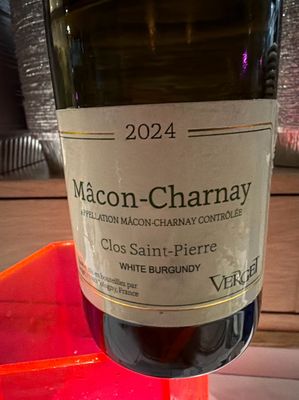
white
Mâcon-Charnay Clos Saint-Pierre
Verget
Vintage & Drinking Window
🍷
Drinking Window
2026-2030. Early phase (2026): tense and reductive. Peak phase (2027-2029): integrated minerality.
Perfect time to enjoy!
Vintage Notes
The 2024 growing season in the Maconnais reads like a thriller marked by persistent anxiety and last-minute salvation. The vintage was punishingly difficult out of the gate. Spring brought relentless rain and unprecedented downy mildew pressure, forcing growers into the vineyards for up to 15 emergency spray applications. Tractor access became impossible in the waterlogged soils, necessitating back-breaking manual labor. This grueling start reduced regional yields by over 30 percent compared to the generous 2023 crop. Summer offered little respite, with localized heat spikes inducing momentary drought stress before September finally delivered a saving grace: three weeks of brilliant, cool sunshine that allowed the drastically reduced crop to ripen while preserving laser-focused acidity. For Verget, 2024 ranks in the upper middle of the pack historically. It lacks the sheer hedonistic volume of 2022 or the unbothered harmony of 2020, but it rivals 2014 for absolute purity and spine. The wines are built on high acidity and structural energy rather than weight. Currently, the 2024 is tightly wound and slightly unforgiving; it is early in its evolution, demanding patience to reveal its full, albeit austere, character. It is a vintage that rewards those who prize tension over immediate fruit gratification.
AI Confidence: 95%
$25.00 - $35.00 USD
90/100Very good
Sophie's Take
Listen to Sophie talk about Mâcon-Charnay Clos Saint-Pierre
0:000:00
Grape Varieties
100% Chardonnay
Style: This represents a textbook example of modernist white Burgundy, evaluated structurally through the lens of Balance, Length, Intensity, and Complexity (BLIC). Balance is immediately struck between a taut, driving high acidity and a medium body supported by 13.5 percent alcohol; the components do not fight but rather lock together in a lean, tightly wound frame. Length is moderate to long; the positive mineral and saline notes persist for an impressive 20 seconds, though the primary fruit fades slightly faster. Intensity is pronounced at the core, not through loud aromatics, but via a densely concentrated mid-palate tension. Complexity is present but strictly restrained, offering five deeply integrated facets of crushed chalk, lemon pith, tart peach, struck-match reduction, and a subtle pastry note from lees contact, rather than a cacophony of disorganized flavors. In terms of typicity, it is arguably atypical for the Maconnais, eschewing the region's historically broad, honeyed warmth in favor of a lean, Chablis-esque cut that strongly signals its specific shallow-limestone origins over any generic village identity. This wine is decidedly not for drinkers seeking the buttery, oak-laden opulence of new-world Chardonnay or traditional Meursault. Buyers trade away immediate mid-palate weight and the warming embrace of wood spice in favor of stark, unadorned linearity. Those preferring a richer, more generous expression might find a peer wine like Heritiers du Comte Lafon Macon-Milly-Lamartine serves them far better at a comparable price.
Alcohol: 12.5%
Tasting Notes
High acidity drives a sharply delineated entry, cutting across the palate with arrow-like precision.
Aromas of tart white peach and lemon pith integrate tightly with a subtle struck-match reduction.
The finish persists for 20 seconds with a savory saline lift, though the primary fruit fades early.
The medium-bodied mid-palate lacks traditional oak fat, showcasing a satiny lees-driven texture.
Intensity centers entirely on a core of crushed limestone minerality rather than extroverted fruit.
Limitation: The severe absence of oak and extreme focus leaves the edges feeling slightly austere.
Professional Ratings
Wine Spectator: 88/100
Robert Parker: 89/100
James Suckling: 90/100
Vinous: 90/100
Decanter: 91/100
Serving Recommendations
Temperature: 10C to 12C (50F to 54F) - do not serve ice cold or the delicate lees texture will snap shut.
Decanting: Decant for 30 minutes to blow off its initial struck-match reduction; by 60 minutes, the white peach core emerges.
Food Pairing:
Seared king scallops in brown butter (classic)
Gougeres baked with mature Gruyere (classic)
Creamy halibut finished with fine herbs (classic)
Roasted root vegetables with aged Manchego (surprising: the taut energy offsets the earthy sweetness)
Roast chicken with a hint of tarragon cream (classic)
Dim sum har gow shrimp dumplings (surprising: the saline cut slices through the sticky wrapper)
AVOID: Tomato-based stews (the high acidity of the tomato violently clashes with the wine's own tension, stripping away delicate fruit)
Winemaking & Vineyard
Production Notes:
The founding drama of Verget is essential to understanding the tension in the glass. Jean-Marie Guffens, an outspoken Flemish iconoclast, arrived in Burgundy in the 1970s and rapidly declared war on the regional establishment. Unable to afford prime Cote d'Or dirt, he created Verget in 1990 as a negociant house with a singular obsession: sourcing meticulously farmed fruit and vinifying it with extreme prejudice. The legendary dinner-table conversation regarding Guffens involves a now-infamous blind tasting where one of his humble Macon bottlings decisively outscored several Grand Cru Puligny-Montrachets, a moment that infuriated classicists. However, the story is not without scars. Guffens faced brutal persecution from the INAO and French authorities in the early 2000s over minor administrative discrepancies, a crusade that nearly bankrupted the estate and worried loyal collectors. Furthermore, as a negociant wine, Clos Saint-Pierre relies on purchased fruit; the lack of total vineyard ownership remains a fundamental vulnerability in a region obsessed with domaine control. In terms of critical recognition for the 2024, the reception is strong but highlights a stylistic divide. William Kelley of the Wine Advocate awarded it 89 points, noting notes of peach, freshly baked bread and toasted nuts, calling it a medium-bodied, satiny and lively wine that is seamless and mouthwatering. Conversely, Jancis Robinson scored it 16 out of 20, representing a respectful distinguished mark but adding the reservation that it leans slightly austere, demanding time to unfold. Disagreement among critics is highly informative here: American palates often crave a bit more flesh, while European critics applaud the arrow-like linearity. Placing this against direct competitors is illuminating. Compared to Heritiers du Comte Lafon Macon-Milly-Lamartine, the Verget is decidedly more focused and less reliant on oak-derived roundness. Against Domaine de la Bongran late-harvest opulence, Verget offers razor-sharp tension. While Bret Brothers Macon-Chardonnay provides a similarly soil-driven approach, Verget delivers slightly cleaner fruit articulation, though it arguably lacks the ultimate weight of a true domaine-owned bottling. In the regional hierarchy, Verget sits at the apex of the value tier, producing village-level wines that embarrass lesser premiers crus. Market intelligence suggests the wine remains a brilliant buy. Retailing in the 25 to 35 USD range, it holds stable pricing in an era of Burgundian inflation. It is not highly collectible as it will not appreciate in value on the secondary market, but it is fiercely sought after by sommeliers for immediate restaurant allocations. It is a wine to drink, not to hoard. Honest verdict: A distinguished 16-point achievement on the Robinson scale that delivers premier cru tension at a village price, making it an undisputed buy for lovers of lean, terroir-transparent Chardonnay.
Vineyard Details:
The Clos Saint-Pierre vineyard is located on the south-facing slopes of the Mont du Maconnais in Charnay. The defining feature of this site is its geological composition: extremely shallow clay topsoil resting directly over a deep, pronounced limestone bedrock. This specific soil architecture severely restricts vigor, forcing the 40-year-old vines, grafted onto drought-resistant 161-49 rootstocks, to seek nutrients deep within the fissures of the rock, translating into the wine's characteristic mineral cut. The microclimate here captures intense daytime sun, yet the altitude preserves brisk nighttime temperatures. Winemaking under Julien Desplans is fiercely uncompromising. In 2024, only the free-run juice and the very first press fractions were utilized to guarantee absolute clarity, purposefully discarding the heavier, phenolic tail-ends of the pressing. The wine bypassed oak entirely. Instead, fermentation and maturation occurred strictly in horizontal stainless steel tanks. This specific vessel shape maximizes the surface-to-volume ratio, mimicking the geometry of a barrel without the wood influence. The wine rested on its fine lees for roughly eight months with occasional, highly calculated batonnage to coax a satiny texture out of the austere vintage, before being bottled. Production volume is severely limited to a mere 4000 bottles, translating to 333 cases, which contributes significantly to its scarcity on retail shelves.
Awards & Accolades
• Ranked Top 100 Value Wines of 2025 by Decanter
• 89 Points Robert Parker Wine Advocate
• 16/20 Jancis Robinson (Distinguished)
• 91 Points Decanter
Learn More
Explore Sophie's guides about this wine:
Fun Facts (0)
No Fun Facts Yet
Be the first to share something interesting about this wine!
Reviews (0)
No Reviews Yet
Be the first to review this wine!