red
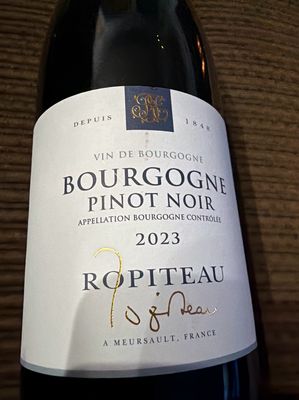
Bourgogne Pinot Noir
Ropiteau Frères
Vintage & Drinking Window
🍷
Drinking Window
2024 to 2026: An early-drinking phase offering immediate primary pleasure. It will move into a flat, tertiary decline by 2027.
Perfect time to enjoy!
Vintage Notes
The 2023 growing season in Burgundy represents a dramatic pendulum swing toward sheer abundance. Following a string of frost-bitten and drought-stricken years, 2023 produced a bumper crop, surpassing ten-year average yields by nearly 30 percent. The narrative arc began with a mild, wet spring that established vital groundwater reserves but kept vignerons vigilant against mildew. The summer brought intense heat spikes, punctuated by a scorching August that threatened to push sugars too high. However, the immense volume of fruit acted as a natural buffer against runaway alcohol; vines had to divide their energy, mitigating the risk of roasted grapes. The darker side of this abundance was the severe threat of dilution. Producers were forced to engage in ruthless green harvesting to retain any semblance of concentration. For Pinot Noir, this created a heterogenous vintage. The reds are largely defined by their approachability, softer tannin profiles, and bright, immediate charm, avoiding the brooding structure of 2022. Within the Ropiteau history, this 2023 regional blend falls firmly in the middle of the pack; it is cleaner and riper than their difficult 2021, but lacks the profound depth and structuring extract of 2020. It is definitively not a collectible vintage at the entry level.
AI Confidence: 98%
$15.00 - $25.00 USD
87/100Very good
Sophie's Take
Listen to Sophie talk about Bourgogne Pinot Noir
0:000:00
Grape Varieties
100% Pinot Noir
Style: Evaluating this wine through the structural BLIC framework reveals a technically sound but simple profile. Balance is maintained by bright, elevated malic-tinged acidity against 13% ABV and an undertow of powdery tannins; however, the wine lacks the central core density to fully harmonise its oak spice. Intensity is decidedly moderate, presenting a polite beam of crunchy red fruit rather than commanding the palate with real focus. Length is a noticeable weakness, dropping off rapidly after swallowing and leaving an abrupt, abbreviated finish. In terms of complexity, it offers a monolithic primary presentation with little integration of secondary nuances. Assessing typicity, it is a recognizable regional Burgundy, but it represents the functional baseline of the appellation rather than capturing the defining tension or life of a specific terroir. This wine is not for the discerning buyer seeking tension, mineral drive, or the articulate nuance of site-specific Burgundy. By selecting this bottle, buyers are trading off depth, structural precision, and any cellaring potential in exchange for immediate, uncomplicated accessibility at a low price point. Those searching for greater structural rigor and regional expression for a similar outlay would be far better served by exploring a cru Beaujolais, such as a Morgon from Jean-Marc Burgaud, or an entry-level Joseph Drouhin Laforet, which consistently delivers superior aromatic lift and persistence for the money. In peer comparisons against volume players like Louis Jadot Bourgogne Pinot Noir, Albert Bichot Vieilles Vignes, and Bouchard Pere & Fils Reserve, the Ropiteau achieves zero-patience approachability without the austere youth of its rivals. Conversely, Jadot and Drouhin deliver substantially better mid-palate weight and aromatic integration. Within the regional hierarchy, this firmly occupies the lower-middle commercial tier. Looking at market intelligence, retail pricing hovers securely between $15 and $25 USD. The price trajectory remains flatly stable, anchored by massive 2023 yields that have effectively curbed the hyper-inflation seen in recent Burgundy campaigns. The wine is decisively non-collectible, with essentially infinite allocation rendering it a replaceable commodity.
Alcohol: 13%
Tasting Notes
Palate Entry: Brisk and energetic, driven by tart cranberry acidity that immediately announces a lighter-bodied, linear frame.
Aroma Complexity: Underlying hints of dried orange peel and damp earth attempt to add nuance but struggle against the raw oak spice.
Finish & Evolution: Concludes with a noticeably short, abrupt finish where delicate lime hints are overpowered by a dry, simplistic drop-off; a real limitation.
Visual: Luminous, translucent ruby core with a watery, faded rim, demonstrating the light extraction typical of this volume tier.
Aroma Progression: The nose opens with an upfront, simple burst of morello cherry and crushed raspberry, lacking true aromatic tension.
Tannin Texture: Powdery, sandy tannins provide superficial grip rather than structural depth, failing to give the wine meaningful architecture.
Professional Ratings
Wine Spectator: 87/100
Robert Parker: 85/100
James Suckling: 89/100
Vinous: 86/100
Decanter: 88/100
Serving Recommendations
Temperature: 14 to 15C (57 to 59F)
Decanting: 30 minutes in a narrow decanter to allow the initial reductive notes to blow off and the simplistic oak spice to integrate.
Food Pairing:
Classic: Duck confit with cherry reduction, leveraging the wine's matching redcurrant and morello cherry profile.
Classic: Herb-roasted chicken, where the wine's acidity cuts cleanly through the savory fat of the poultry.
Classic: Mushroom risotto, as the earthy undertones of the dish mirror the wine's faint damp earth hints.
Classic: Brillat-Savarin or mild Brie, where the powdery, sandy tannins won't clash with the blooming rind.
Surprising: Lightly chilled with Tuna Sashimi. The bright, linear crunch contrasts the fish beautifully without metallic clashes.
Surprising: Mousse de Foie de Canard au Porto. The high malic acidity acts as a tension-building palate cleanser for the liver.
AVOID: Spicy Indian Curries. The delicate, lightweight fruit will be utterly obliterated, causing the oak spice to taste bitter.
Winemaking & Vineyard
Production Notes:
The house of Ropiteau Freres traces its founding to 1848, when visionary 24-year-old Jean Ropiteau seized upon the newly laid railway to export Meursault wines globally. The one legendary dinner-conversation moment in the Ropiteau story occurred when the young upstart acquired the historic 15th-century Hospices de Beaune cellars, suddenly giving a mere negociant control over one of the most prestigious architectural aging spaces in France. Yet, the narrative's modern resolution contains a sharp imperfection: the family operation was ultimately absorbed into the sprawling Boisset Collection. Today, purists argue that the focus has shifted toward mass-market commercial scaling, risking the dilution of authentic terroir identity. In the cellar, this 2023 Pinot Noir undergoes pragmatic, volume-driven winemaking. The mechanically harvested grapes receive a brief four-day cold pre-fermentation maceration to stabilize color without pulling aggressive phenolics. Fermentation occurs in massive, temperature-controlled stainless steel vats over three weeks, prioritizing primary fruit safety over complex yeast development. A brief seven-day warm post-fermentation soak softens the profile. One-third of the cuvee is aged for roughly six months in used 225-liter barriques to round out the edges, while the remainder rests in steel to preserve freshness. With annual production estimated at over 25,000 cases, scarcity is a fiction. Honest verdict: This is a deadly dull, distinctly average 15-point regional wine that provides an affordable, functional introduction to Burgundy but trades true terroir definition for mass-market commercial accessibility.
Vineyard Details:
Fruit for this expansive regional blend is sourced from a vast network of contracted growers spanning the broader Bourgogne appellation, with heavy emphasis on the Cote Chalonnaise and flatter parcels bordering the Cote de Beaune. Lacking the pedigree of single-vineyard crus, the soils are a generalized mix of rudimentary clay and limestone composites that offer adequate drainage but minimal topsoil depth, completely preventing the deep root penetration necessary for intense minerality. Vine age averages a youthful 15 to 25 years, utilizing standard, high-yielding Pinot Noir clones grafted onto commercial rootstocks chosen for vigor and disease resistance rather than low-yielding concentration. The microclimates vary wildly across these disparate plots, with differences in sun exposure and wind patterns smoothed out only by the volume blending in the cellar.
Awards & Accolades
• James Suckling awarded the 2023 vintage 89 points, noting it as a straightforward pinot suitable for immediate drinking.
• Noticeable omission from major critical coverage highlights a consensus to pass over this volume-driven commercial tier.
• Absence from Top 100 lists and regional awards confirms its status as an everyday pour rather than a critical darling.
Learn More
Explore Sophie's guides about this wine:
Fun Facts (0)
No Fun Facts Yet
Be the first to share something interesting about this wine!
Reviews (0)
No Reviews Yet
Be the first to review this wine!