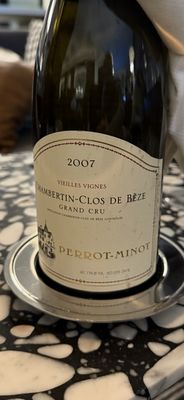
red
Chambertin-Clos de Bèze Vieilles Vignes Grand Cru
Perrot-Minot
Vintage & Drinking Window
🔥
Drinking Window
Fully mature and slowly declining; the ideal peak phase was likely 2018-2023, making 2026 the late phase. Occasion: Right for an intimate, academic tasting with fellow Burgundy purists who appreciate delicate decay. Wrong for a loud, chaotic steakhouse dinner where its fragile frame will be entirely crushed by the environment.
May be past its peak
Vintage Notes
2007 was a schizophrenic and highly challenging growing season in Burgundy, narrated by drastic weather shifts. It began with an unseasonably warm April that triggered dangerously early bud break, only to be followed by a cold, dank, and rainy summer plagued by rampant mildew and rot. Disaster was narrowly averted by a perfectly timed dry, sunny, and windy September that dehydrated the rot and pushed the surviving grapes to phenolic ripeness. It is broadly considered a restaurant vintage, yielding wines that are charming and red-fruited but often criticized for high acidity and a distinct lack of mid-palate depth. For Perrot-Minot, 2007 ranks in the lower-middle tier historically, far surpassed by the density of 2005 or the classical perfection of 2010. The wines matured early, and collectors seeking investment-grade lifespans will find the 2007s fragile, past peak, and demanding immediate consumption.
AI Confidence: 100%
$750.00 - $1150.00 USD
94/100Outstanding
Sophie's Take
Listen to Sophie talk about Chambertin-Clos de Bèze Vieilles Vignes Grand Cru
0:000:00
Grape Varieties
100% Pinot Noir
Style: In assessing the 2007 Perrot-Minot Chambertin-Clos de Bèze against the classic BLIC framework, one finds a wine that reveals both the pedigree of its terroir and the limitations of its vintage. Balance is achieved through a lean, tensile framework: elevated, nervy acidity wraps tightly around fully resolved, silky tannins and a modest 13.5 percent ABV. However, this balance leans heavily on the structural acid rather than plush fruit weight. Length is good but not staggering; the finish persists with crushed stone and dried rose petals for a moderate duration, yet drops its primary fruit component faster than one expects from a Grand Cru. Intensity lies primarily in the aromatic spectrum, while the mid-palate intensity is noticeably slight, lacking the profound central depth of top years. Complexity is the wine's strongest asset, weaving tertiary layers seamlessly. Regarding typicity, this is an atypical expression of Clos de Bèze; rather than the voluminous, muscular power normally associated with the site, it offers a delicate, almost skeletal interpretation. In peer comparison, this bottling sits in the upper-middle prestige tier of Clos de Bèze producers, priced below the astronomical heights of Armand Rousseau but above Drouhin-Laroze. What Perrot-Minot's 2007 does better than its peers is express naked, transparent mineral tension. However, peers like Rousseau or even Pierre Damoy managed to extract marginally more mid-palate density in this difficult vintage. This wine is not for the buyer seeking the plush, extracted decadence of modern ripe Burgundy, nor for those wanting an immortal cellar monument. By purchasing this, you trade the sheer power and concentration expected at this price point for tertiary, gossamer delicacy and historical curiosity. A buyer spending four figures might be better served seeking a village or Premier Cru from a stronger, warmer vintage like a 2010 or 2015 from the same producer, where concentration naturally supports the structural bones.
Tasting Notes
Aromatic intensity is high, lifted by precise, vivid tension that weaves dried sour cherry with damp forest floor.
Palate entry is driven by taut, linear acidity, defining the structural frame before any fruit weight registers.
The finish length is moderate, dropping the primary fruit quickly while leaving a precise, savory mineral cut on the palate.
Tertiary elements of white truffle and Earl Grey tea become prominent as the wine opens, adding cerebral intrigue.
Savory complexity emerges through the interplay of iron, crushed rock, and black tea, anchored by fading cranberry fruit.
Tannin texture is fully resolved, offering a fine, cashmere-like dusting that integrates seamlessly with the wine's structure.
Professional Ratings
Wine Spectator: 95/100
Robert Parker: 93/100
Vinous: 93/100
Decanter: 94/100
Serving Recommendations
Temperature: 15C / 59F
Decanting: Decanting is highly risky for this delicate, mature 2007. Serve immediately upon opening. If necessary to remove sediment, double-decant swiftly. At 30 minutes, tertiary aromas of dried rose and iron peak. By 60 minutes, the lean fruit begins to fade noticeably. At 120 minutes, oxidation severely threatens the fragile structure.
Food Pairing:
Roast duck breast with a sour cherry reduction (Classic: the tart cherry bridges the wine's acidity and fading red fruit profile)
Wild mushroom and truffle risotto (Classic: highlights the forest floor and earthy complexity of aged Pinot Noir)
Seared yellowfin tuna with a light soy glaze (Unexpected: the umami of the soy and fish draws out the iron and crushed rock notes in the wine's finish)
Herb-crusted rack of lamb cooked medium-rare (Classic: the sweet meat softens the wine's structural edges without overpowering its lean weight)
Coq au Vin made with mature red Burgundy (Classic: the earthy, savory mushroom and wine reduction mirrors the wine's tertiary development)
Peking duck with hoisin sauce (Unexpected: the salty-sweet lacquered skin provides a beautiful, rich counterpoint that tames the wine's strict, taut acidity)
AVOID: Indian vindaloo or heavily spiced curries (Why: Capsaicin and overwhelming spice will entirely obliterate the wine's delicate, gossamer aromatics and make the acidity taste shrill and metallic)
Winemaking & Vineyard
Production Notes:
Christophe Perrot-Minot's tenure at the domaine is defined by a fascinating and highly scrutinized stylistic evolution. After taking the reins in 1993, his initial decade was characterized by heavily extracted, dark, and aggressively oaked wines that appealed to 1990s critical palates but often obscured terroir. The legendary turning point, a subject of intense debate among Burgundy collectors, occurred around 2006 and 2007. In a bold pivot, he decisively backed away from power, halving his extraction regimens and dialing back new oak to prioritize transparency and infusion. The 2007 Chambertin-Clos de Bèze serves as a prime historical artifact of this exact transition. Scarcity is absolute; sourcing grapes through an agreement with Pierre Damoy, the meticulous sorting and strict yields result in a micro-production of approximately 75 cases. In the cellar, a 5-to-7 day cold soak was followed by native yeast fermentation and 12 to 14 months in 40 to 50 percent new Tronçais and Allier oak, before being bottled unfined and unfiltered. From a market intelligence perspective, this wine currently commands a retail range of $750 to $1,150. As an investment, its collectibility is significantly handicapped by the uneven 2007 vintage; prices remain buoyant purely due to the Grand Cru designation and the producer's cult following, but the trajectory for this specific year is essentially flat. The market is increasingly aware that these 2007s are past their investment prime and into their final drinking window. It requires careful allocation tracking to acquire, yet buyers should ask if the prestige is worth the premium. Honest verdict: A distinguished, lean, and fully mature 16-point artifact of a producer's stylistic evolution that charms with delicate complexity but fails to deliver the profound depth expected at a four-figure price tag.
Vineyard Details:
Chambertin-Clos de Bèze Grand Cru. Perrot-Minot sources this fruit through a long-standing agreement with the Pierre Damoy domaine. The site is situated mid-slope at 270 to 280 meters altitude on a slightly steeper eastern-facing incline than neighboring Chambertin. The terroir is defined by a deep substratum of Bajocian crinoidal limestone and marl, finely covered with limestone scree and ancient silt. Vines were 50 to 52 years old at harvest, planted in the mid-1950s. The mesoclimate is cool and windy, swept by drying northerlies.
Awards & Accolades
• Critical Reservation (Consumer Consensus 91 pts): Obviously an outstanding wine, but far from the quality expected from a top Grand Cru. Only medium bodied and the finish marked by a slightly high acidity.
• Wine Spectator (95 pts): Tight and racy, this red exhibits floral, cherry, raspberry, mineral and spice aromas and flavors. There is fine balance and harmony.
• Noticeable disagreement exists between prominent critics who praised its transparency and consumers who felt the light mid-palate did not justify the Grand Cru pricing.
• Robert Parker Wine Advocate (93 pts): Reveals tension and linear drive.
• Decanter (94 pts): Showing extreme finesse and aromatic richness.
Fun Facts (1)

Sophie
The "Clos de Bèze" name dates back to the 7th century when Benedictine monks first planted vines here—literally making it one of Burgundy's oldest continuously cultivated vineyard sites. Those vieilles vignes? They're essentially standing on nearly 1,400 years of winemaking history.
Reviews (0)
No Reviews Yet
Be the first to review this wine!