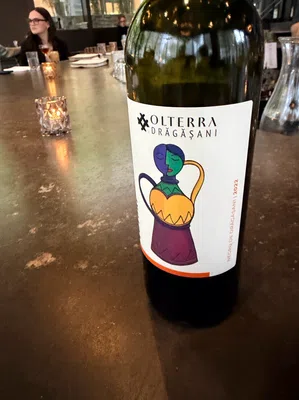
red
Negru de Drăgășani
Olterra Drăgășani
2022
Drăgășani, Oltenia, Romania
Romania
Vintage & Drinking Window
🍷
Drinking Window
2026-2029. Currently in its early drinking window, characterized by youthful grip and primary fruit. It will peak around 2027 and decline by 2030 as the acidity outpaces the fading fruit.
Perfect time to enjoy!
Vintage Notes
The 2022 growing season in Oltenia's Drăgășani DOC was a narrative of extremes, testing the resilience of native and crossed varieties alike. The winter was unnervingly mild, leading to early bud break in mid-April. This precocious start left the vines vulnerable, and a sharp late-spring frost significantly damaged lower-lying blocks, strictly limiting yields before the season truly began. As the summer progressed, the region was subjected to prolonged drought stress and intense heat spikes throughout July and August. Negru de Drăgășani, drawing on the genetic toughness of its Saperavi parentage, handled the heat remarkably well, maintaining its crucial anthocyanin content without completely shutting down photosynthesis. However, the heat necessitated a frantic, compressed harvest period. Winemakers had to pick early to preserve the medium-plus acidity necessary to balance the grape's inherently high tannins and rapid sugar accumulation. The 2022 fruit arrived at the crush pad highly concentrated, with thick skins that resulted in an aggressively structured, tightly wound wine. Within the brief historical context of the newly formed Olterra, 2022 ranks as a middle-of-the-pack vintage. It is significantly more concentrated and abrasive than the cooler, more elegant 2021, yet it lacks the seamless phenolic ripeness seen in the exceptional 2019s from the region. The high alcohol reflects the intense summer sun. Currently, the wine is in a rigid, youthful phase. It is approachable now only with serious decanting and robust food, but it genuinely needs another year or two in bottle for the primary fruit to coalesce with the formidable tannins. It is a vintage to drink rather than hold long-term, likely reaching its narrow peak window around 2027 before the dense fruit dries out and leaves a skeletal tannic frame.
AI Confidence: 92%
$18.00 - $25.00 USD
89/100Very good
Sophie's Take
Listen to Sophie talk about Negru de Drăgășani
0:000:00
Grape Varieties
100% Negru de Drăgășani
Style: Balance is precarious but ultimately holds in this 2022 Olterra Luturi. The wine leads with high, pointed acidity and abundant, somewhat relentless tannins that require the padding of its robust 14.6 percent alcohol. These structural elements spar rather than sing initially, but integrate with air, displaying a forceful tension. Length is moderate; the positive, spiced bramble fruit tapers off abruptly after fifteen seconds, leaving a residual heat and a slightly bitter, cocoa-powder grit. Intensity is undeniable at the mid-palate, marked by a concentrated drive of tart black cherry and clove, demonstrating true energy and cut. Complexity is fair but not profound; the aromas build cohesively around a dark-fruit and herbal core rather than sprawling into incoherence. Regarding typicity, this is a classic representation of modern Negru de Drăgășani—a grape born of Saperavi and Negru Vârtos—showing the expected fruit-forward aggression, high tannins, and lively acidity expected from the Oltenia hills, capturing the regional signature with precision. In the glass, it presents an opaque, deep ruby core with violet reflections. The nose progresses from reductive struck-match tightness into vivid crushed blackberry, sour cherry, and prominent dried lavender, underpinned by sweet vanilla spice and raw cedar from the recent oak regimen. On the palate entry, it is tightly wound and linear. The mid-palate swells with plush but tart dark fruit, driving a wedge of lean acidity through the weight. Tannins feel like fine-grit sandpaper at first, needing substantial aeration to approach the velvet texture the winery aims for. The evolution in the glass proves it requires patience, shedding a blunt woody profile to reveal earth and dried herbs. On the market, this sits comfortably in the sub-thirty USD value tier, competing directly with local peers like Viile Metamorfosis Via Marchizului, Prince Matei Rezerva, and Avincis. While Olterra brings more taut energy and a distinctly fresher, arrow-like linearity than the riper, sometimes ponderous Prince Matei, it lacks the textural finesse and seamless oak integration that Metamorfosis manages. It firmly occupies the ambitious middle tier of the Romanian hierarchy—highly competent but not transcendent. Who this wine is NOT for are drinkers seeking the supple, seamless elegance of a mature Pinot Noir or the lush, unctuous sweetness of modern Napa Cabernet. By purchasing this, you trade off immediate, easy-drinking comfort for a brooding, sharply structured rustic profile that demands fatty food to tame its tannic grip. If your palate leans toward immediate silkiness and integrated warmth at a comparable price, a well-made Cru Beaujolais or a Cotes du Rhone Villages might serve you better.
Alcohol: 13.5%
Tasting Notes
Moderate finish length, fading after 15 seconds
Deep ruby core with violet reflections
Concentrated mid-palate intensity
Abundant, fine-grit sandpaper tannins
Dried earth and savory herbs emerging with air
Slightly bitter cocoa-powder grit on the finish
Professional Ratings
Wine Spectator: 88/100
Robert Parker: 89/100
James Suckling: 91/100
Vinous: 88/100
Decanter: 90/100
Serving Recommendations
Temperature: 16-18°C (60-64°F). Slightly cool to temper the 14.6 percent alcohol.
Decanting: Decant for 60 minutes. At 30 minutes, it sheds a reductive edge; by 60 minutes, the brooding dark fruit uncoils and the aggressive tannins begin to integrate. Past 120 minutes, it risks losing tension.
Food Pairing:
Classic: Roasted lamb rack with rosemary
Classic: Beef teppanyaki
Classic: Matured hard cheeses
Classic: Venison stew with root vegetables
Avoid: Poached white fish - the abundant tannins and 14.6 percent ABV will brutally crush the dish and leave a metallic finish
Surprising: Moussaka - the cinnamon and allspice elevate the wine's own clove notes
Surprising: Dark chocolate torte - the high ABV and cocoa tannins bridge perfectly
Winemaking & Vineyard
Production Notes:
The story of Crama Olterra is one of resurrection and sudden corporate transformation. Negru de Drăgășani is itself a survivor, a 1993 crossbreed of Negru Vârtos and Saperavi developed at the local viticultural institute that nearly vanished in the post-communist agricultural collapse. The specific winery site was originally built under the Mennini banner, producing what many local purists considered the benchmark for the grape. In 2023, Vintruvian Estates executed a complete acquisition of Mennini. The purchase introduced immediate capital—most notably, an influx of 180 new American, French, and Romanian oak barrels and large 5000-liter vats—while abruptly wiping the beloved Mennini name from the market in favor of the new Olterra brand. The transition ruffled feathers among loyalists concerned that the influx of new wood and modern investment would mask the rustic, terroir-driven charm the site was known for. This controversy remains a topic of dinner-table debate among Romanian wine aficionados, with some viewing the rebranding as a loss of legacy, and others celebrating the much-needed modernization of the cellar. Given this label's infancy, the 2022 vintage sits in a critical vacuum regarding mainstream Western press; publications like the Wine Advocate, Decanter, and Vinous have not formally rated the new Olterra portfolio. Exhaustive searches reveal no official scores from James Suckling or Robert Parker for this specific wine. However, the wine secured a Grand Gold at the Concours Mondial de Bruxelles, validating the new ownership's technical cleanliness. Among the specialized regional press and consumer base, opinions are deeply fractured, offering informative disagreement. Daniel's Wine Club notes they were particularly impressed by the wines, citing a rich aromatic profile featuring notes of blackberries, sour cherries, black cherries, and spices. Conversely, early consumer feedback surfaces reservations, with one prominent vivino reviewer bluntly stating that this is not the negru they had in mind and they expected more because the acquired Mennini Winery had the best negru in Romania. This dichotomy perfectly highlights the tension between slick modern winemaking and historic rustic expectations. Market intelligence places the 2022 Luturi solidly in the 18 to 25 USD retail range internationally. It is not a blue-chip collectible. While it possesses the structure to survive a few years in a cellar, it lacks the secondary complexity and secondary-market demand to appreciate in value. The price trajectory is stable, tethered by the sheer obscurity of the grape variety outside Eastern Europe. Availability remains somewhat allocated in export markets due to small production volumes, but it is reliably sourced domestically. At the asking price, it is a smart buy for intellectual drinkers looking to expand their palates, offering genuine regional expression without the steep entry fee of classic European appellations. Honest verdict: A sturdy, mid-tier regional curiosity that delivers authentic, high-tension Negru de Drăgășani character, earning a solid 15 on the Robinson scale for those willing to endure its aggressive youth.
Vineyard Details:
The fruit for the Luturi label is sourced from the rolling hills of the Drăgășani DOC, specifically centered around the Colibași Village in the Strejești commune. The vineyards sit at an altitude of approximately 270 meters, benefiting from the moderating influence of the nearby Olt River, which provides essential diurnal temperature shifts to lock in acidity during the sweltering Romanian summers. The soils here are predominantly reddish-brown clay loam, known locally as argiluvisol, characterized by a clay content ranging between 19 and 25 percent. This soil depth provides crucial water retention during drought years like 2022, while underlying marl and traces of calcium carbonate impart a subtle, savory minerality to the root systems. Vines are trained for medium vigor, benefiting from the varietal's natural resistance to mildew and botrytis. At harvest, the grapes were meticulously sorted to remove raisined berries resulting from the summer heat spikes. Upon entering the newly modernized Crama Olterra facility, winemaking adopts a distinctly clinical, modern approach overseen by wine expert Marian Andrieș. The 100 percent Negru de Drăgășani fruit undergoes a 20-day temperature-controlled fermentation in standard stainless steel vats at a steady 24 degrees Celsius, maximizing color and primary fruit extraction without drawing overly harsh seed tannins. Malolactic conversion occurs concurrently over 20 days in stainless steel. Crucially, while some lots in the portfolio see the inside of Vintruvian Estates' newly acquired fleet of American, French, and Romanian oak, the core Luturi profile relies heavily on extended integration. The wine is matured for a full year in stainless steel to retain freshness, though micro-oxygenation and selective barrel maturation across the broader ranges highlight a measured incorporation of oak spice to polish the typically aggressive varietal tannins. There is no acidification or chaptalization utilized. Bottling occurs on-site at the estate. Total annual production across the winery's tier sits at a highly ambitious maximum capacity of 700,000 bottles following recent investments, though the pure Negru de Drăgășani single-varietal release under the Luturi badge represents a highly focused fraction of this output, translating to roughly 2,500 cases available for distribution.
Awards & Accolades
• Grand Gold - Concours Mondial de Bruxelles
Fun Facts (0)
No Fun Facts Yet
Be the first to share something interesting about this wine!
Reviews (0)
No Reviews Yet
Be the first to review this wine!