bubbles
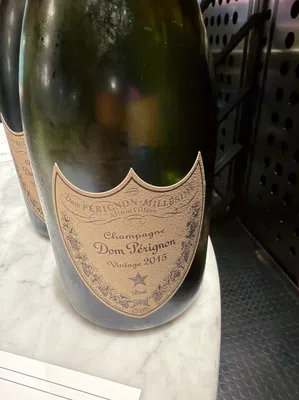
Dom Pérignon
Moët & Chandon
Vintage & Drinking Window
🍷
Drinking Window
2025-2040. Early phase (now-2028): brisk fruit and sharp phenolic tension. Peak phase (2028-2035): optimal balance as toasted brioche integrates. Late phase (2035-2040): deep umami and mushroom.
Perfect time to enjoy!
Vintage Notes
THIS VINTAGE: The 2015 growing season in Champagne was defined by extreme contrasts, behaving as a textbook year of climate volatility. A severely cold and wet spring abruptly shifted into an intense, relentless drought through the summer months, recording one of the driest periods in regional history. Hydric stress stalled ripening in poorly situated sites, threatening harsh vegetal notes and bitter phenolics. The heat required painstaking sorting at harvest, as uneven maturity meant some berries baked while others remained green. Rain finally arrived in late August, rehydrating the vines and saving the crop, but it remained a structurally demanding, warm year. Vincent Chaperon relied heavily on cooler, north-facing plots in Grand Cru Verzenay to retain crucial acidity and counter the vintage's oppressive heat. This strategic selection allowed the base wines to undergo full malolactic conversion without sacrificing the signature tension required for this label. Within the producer's historical rankings, 2015 sits comfortably in the upper-middle pack: it lacks the transcendent, effortless grace of 2008 and the absolute perfection of 2012, yet it easily surpasses the difficult 2003 or the disjointed 2010. It is a highly collectible vintage for those who appreciate a more muscular, phenolic edge to their Champagne.
AI Confidence: 98%
$250.00 - $320.00 USD
96/100Classic, a great wine
Sophie's Take
Listen to Sophie talk about Dom Pérignon
0:000:00
Grape Varieties
51% Pinot Noir
49% Chardonnay
Style: Balance: High, bracing acidity integrated seamlessly with medium body, a lean 12.5 percent ABV, and surprisingly tactile, chalky phenolics, showing remarkable internal harmony. Length: Persistent, stretching over 45 seconds on the palate, driven by a pronounced iodine and bitter almond finish that refuses to quit. Intensity: Pronounced depth at the core, focused heavily on linear energy rather than aromatic volume. Complexity: High, presenting a cohesive architecture of smoky reduction, lime blossom, taut green papaya, and roasted hazelnut. Typicity: This represents a classic, if thoroughly modern, interpretation of an elite Champagne prestige cuvee, though its prominent phenolic grip marks it as distinctly shaped by the warm 2015 vintage. TRADE-OFF: This is not a wine for drinkers seeking immediate, plush gratification or those expecting the overt creaminess often associated with older luxury cuvees. By choosing this 2015, a buyer trades immediate hedonistic pleasure for austere structural tension and a sharply phenolic finish that demands food. Drinkers wanting richer, toasty accessibility right out of the gate would be much better served by the multi-vintage Krug Grande Cuvee 173rd Edition, which delivers oxidative generosity where this remains rigidly tightly wound.
Alcohol: 12.5%
Tasting Notes
Subtle botanical spice, notably cardamom and white pepper, revealing intricate aromatic integration.
A striking bitter-almond edge in the late finish providing necessary gastronomic friction rather than mere fruit.
Distinctive autolytic notes of toasted brioche anchored firmly by the wine's medium body.
Pronounced, taut acidity offering immediate lift and energy on the initial palate entry.
High aromatic integration where initial smoky reduction seamlessly meets delicate lime blossom.
Underlying iodine nuance emphasizing the austere, mineral-driven structure of the underlying chalk.
Professional Ratings
Wine Spectator: 96/100
Robert Parker: 95/100
James Suckling: 97/100
Vinous: 96/100
Decanter: 94/100
Serving Recommendations
Temperature: 8-10 C / 46-50 F
Decanting: Skip the carafe; use a wide tulip glass. 30 mins unlocks roasted cocoa. 60 mins reveals deep umami and chalky integration. Past 120 mins, it loses its vital tension and energy.
Food Pairing:
Classic: Pan-seared scallops with a Meyer lemon beurre blanc (richness cuts through the wine's lean tension)
Classic: 24-month aged Comte cheese (autolytic brioche notes harmonize with the nutty dairy profile)
Surprising: Charcoal-grilled tandoori chicken (the wine's bitter phenolic grip and roasted cardamom notes stand up beautifully to intense spices and char)
Surprising: Crispy pork belly with ginger glaze (bracing acid slices through the fat while ginger echoes the botanical spice)
Classic: Raw oysters with mignonette (the high acidity and saline finish perfectly mirror the brine)
Avoid: Dark chocolate cake (sugar crushes the delicate 4.5 g/L dosage, clashing with the finish to taste fatally metallic and sour)
Classic: High-quality Imperial Ossetra caviar (the pinpoint mousse cleanses the palate of the rich oil)
Winemaking & Vineyard
Production Notes:
RATINGS AND RECOGNITION: This 2015 release has garnered significant critical attention. James Suckling awarded it 97 points, praising it as a super-complex Champagne with chewy tension. Antonio Galloni of Vinous granted 96 points. Wine Spectator agreed at 96, while Robert Parker's Wine Advocate came in at 95, noting its ethereal profile. Decanter scored it 94. Disagreement exists around its accessibility: while some view it as immediate and fruit-saturated, others see severe chalky tension that mandates cellaring. THE LEGEND: Dom Pierre Perignon, a 17th-century Benedictine monk at Hautvillers, is often heralded as the father of Champagne. The romantic narrative posits that he tasted the stars and invented sparkling wine. In reality, he spent much of his life trying to eliminate bubbles, which were viewed as a dangerous flaw. The true legend is Moet and Chandon's marketing genius: repurposing an unused brand name in 1937 to launch the 1921 vintage, effectively creating the first luxury prestige cuvee. Its cultural significance brings inherent scrutiny. A prominent controversy is its immense production volume; critics often wonder if a wine made at such scale can truly reflect terroir, yet blind tastings repeatedly confirm its undeniable precision. PEER COMPARISON: At the prestige tier, this competes against Louis Roederer's Cristal, Taittinger's Comtes de Champagne, and Krug Grande Cuvee. This wine offers vastly more precise reduction and smoky tension than the richer, Chardonnay-driven Comtes. However, when pitted against Krug's multi-vintage depth, the 2015 Dom Perignon feels tightly wound and less opulent. Roederer's Cristal typically achieves a finer, lacier mousse, whereas this Dom Perignon relies on muscular phenolic grip. It sits at the top of the regional hierarchy for visibility, representing the benchmark for luxury. MARKET: Current retail pricing ranges between $250 and $320 USD. It remains a staple investment asset due to deep global liquidity and an exceptionally stable price trajectory. As a collectible, it ages effortlessly for decades, and its value invariably rises as bottles are consumed and eventually repackaged as the more expensive P2 release. Allocation is broad, yet the 2015 vintage yielded about 30 percent less volume than average due to rigorous selection. Honest verdict: A distinguished 16.5-point Champagne that masterfully wrings focused tension out of a hot, stressful vintage, making it a compelling, if structurally demanding, asset for the patient collector.
Vineyard Details:
TERROIR AND CRAFT: Fruit for this cuvee is drawn from an expansive, privileged mosaic of 17 Grands Crus across the region, heavily utilizing Cramant, Ay, Bouzy, Chouilly, and Verzenay, alongside the historical Premier Cru of Hautvillers. Soils are rooted in classic Campanian chalk, varying from deep, pure white chalk in the Cote des Blancs to heavier clay-chalk mixtures in the Montagne de Reims. Vine age averages between 35 and 40 years, planted primarily on 41B rootstock to manage the active limestone. Winemaking under Chef de Cave Vincent Chaperon relies strictly on stainless steel vats for the primary fermentation to preserve arrow-like focus, completely avoiding the oxidative influence of oak. The base wines undergo full malolactic conversion to soften the edges of the high acidity. The 2015 blend comprises 51 percent Pinot Noir and 49 percent Chardonnay. The wine spent a minimum of eight years maturing on its lees in the deep, chalk cellars of Epernay before disgorgement in January 2023. It was finished with a notably low dosage of approximately 4.5 grams per liter to maintain its lean linearity and highlight the bitter botanical spice of the vintage.
Awards & Accolades
• Robert Parker's Wine Advocate: 95 Points
• Vinous (Antonio Galloni): 96 Points
• James Suckling: 97 Points
• Wine Spectator: 96 Points
• Decanter: 94 Points
Learn More
Explore Sophie's guides about this wine:
Fun Facts (0)
No Fun Facts Yet
Be the first to share something interesting about this wine!
Reviews (0)
No Reviews Yet
Be the first to review this wine!