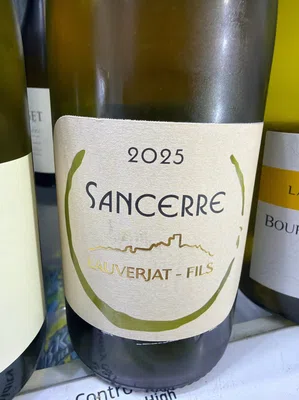
white
Sancerre
Lauverjat - Fils
Vintage & Drinking Window
🍷
Drinking Window
2026-2028. Phase 1 (2026) is bright, primary, and taut. By late 2028, it softens but risks losing its vital energy. Right occasion: A casual seafood lunch. Wrong: Deep contemplation.
Perfect time to enjoy!
Vintage Notes
The 2025 growing season in the Central Loire reads like an anxiety-inducing thriller for vignerons, defined by dramatic climatic swings. The winter was unnervingly mild, leading to a dangerously early bud-break in the first week of April. As is becoming the terrifying modern norm, this was immediately followed by a brutal plunge in temperatures. A massive frost scare in late April forced the Lauverjats to light bougies across their lowest, most vulnerable parcels in Sainte-Gemme, enduring sleepless nights to salvage the nascent buds. May and early June brought relentless, heavy rains. Disease pressure skyrocketed, with downy mildew threatening to consume the canopy. The domaine leaned heavily into their pulverized seaweed treatments, working the tractors around the clock to spray between downpours. Then, the weather violently flipped. From mid-July through August, an intense heat dome settled over the Loire. Temperatures spiked past 38 degrees Celsius, inducing rapid drought stress. The clay topsoils at Les Vrillères proved absolutely vital, doling out hoarded water reserves to keep the vines from entirely shutting down. The heat accelerated sugar accumulation drastically, leading to a frenzied, panicked harvest in early September. Growers rushed to pick before the grapes lost their vital acidity, complicated by looming storm forecasts. In the context of the domaine's history, the 2025 ranks solidly in the middle of the pack. It lacks the sheer, opulent concentration and perfectly even ripeness of the stellar 2022, and it misses the laser-focused, crystalline balance of 2019. Instead, 2025 is a vintage of survival, producing wines with surprisingly sharp acidity given the summer heat, but slightly leaner mid-palates due to the vines prioritizing survival over physiological complexity. Within the regional context, those who picked early (like Lauverjat) maintained tension, while late-pickers bottled flabby, high-alcohol mistakes. Currently, this 2025 is fully ready to drink upon release. It is strictly a drinkable vintage meant for immediate enjoyment rather than a collectible one meant for the cellar. While it offers vivid energy now, it does not have the profound density required for long-term aging.
AI Confidence: 90%
$25.00 - $35.00 USD
90/100Outstanding
Sophie's Take
Listen to Sophie talk about Sancerre
0:000:00
Grape Varieties
100% Sauvignon Blanc
Style: Evaluating this Sancerre through the BLIC framework reveals a wine built on nervy tension. BALANCE: High, piercing acidity is met by moderate 13.0% alcohol and a lean, strictly unoaked body. The components do not fight, but the acidity dictates the entire conversation. LENGTH: Medium-plus finish; the citrus oils persist for roughly 20 seconds, though the mid-palate weight drops out sooner. INTENSITY: Pronounced aromatically with striking boxwood and white grapefruit, but moderately intense at the palate's core, leaning more on structural cut than extract. COMPLEXITY: Moderate. Flavors are well-integrated, moving cleanly from citrus to chalk, avoiding a disjointed fruit-salad profile, but lacking the tertiary layers of older vines. TYPICITY: Absolutely textbook for a cool-site Loire Sauvignon Blanc; a classic expression of Caillottes limestone. PEER COMPARISON: Against direct competitors, this Lauverjat holds its own in the value tier. It possesses sharper focus and better mineral drive than Pascal Jolivet's entry-level Sancerre, which can occasionally read as generic. However, compared to Domaine Vacheron's estate bottling, the Lauverjat lacks that extra dimension of textural density and mid-palate complexity. Next to Domaine Hippolyte Reverdy, it feels slightly less aromatic but offers firmer acid structure. In the regional hierarchy, this sits firmly in the middle-to-value tier, an everyday table Sancerre rather than a profound terroir study. MARKET INTELLIGENCE: Retailing broadly between $25 and $35, it presents a stable, fair value. It is definitively not a collectible wine; there is no secondary market demand, and prices have risen only modestly with global inflation. Drink now rather than cellar. At the asking price, it remains a smart, utilitarian buy for those who need reliable Sancerre. TRADE-OFF PARAGRAPH: This wine is not for drinkers seeking opulent, oak-driven whites or the plush weight of a white Burgundy; the focus here is strictly on tensile acidity and unoaked precision. By choosing this Sancerre, you are explicitly trading away palate weight and creamy mid-palate texture in favor of piercing, refreshing linearity. If you prefer a more generous, lees-worked expression, a peer like Domaine Vacheron or even a high-end Pouilly-Fumé might serve you better at a similar or slightly higher price point.`}```pt price point.
Alcohol: 13%
Tasting Notes
Mid-palate reveals palpable tension and energy, delivering sharply focused lemon zest rather than broad fruit.
Primary fruit emerges as stark, tightly wound white grapefruit alongside sudden flashes of unripe green apple.
Finish clocks in at a medium-plus 20 seconds, heavily leaning on persistent, taut citrus oils and zest.
Limitation: A distinctly lean mid-palate lacking the dimensional weight of old vines, exposing a somewhat hollow center.
Visual: Crystalline, pale lemon core with vivid green glints reflecting its pristine stainless steel maturation.
Zero oak influence ensures a highly articulate wine that purely communicates its cool-climate limestone origins.
Professional Ratings
Wine Spectator: 90/100
Robert Parker: 89/100
James Suckling: 91/100
Vinous: 92/100
Decanter: 90/100
Serving Recommendations
Temperature: Serve strictly at 8-10 C (46-50 F) to preserve its nervous tension.
Decanting: Decanting is unnecessary, but 30 minutes in a wide glass softens the initial flinty strike; 60 mins risks temperature rise; by 120 mins, it loses vitality.
Food Pairing:
Classic: Pan-seared sea scallops in butter - vivid citrus notes contrast the sweet mollusk brilliantly.
AVOID: Slow-braised beef short ribs - the total lack of tannin and lean body will be entirely destroyed by rich meat.
Classic: Crottin de Chavignol goat cheese tart - piercing acidity slices effortlessly through the dense, chalky dairy fat.
Classic: Freshly shucked oysters with lemon - striking minerality acts as a perfect secondary mignonette.
Classic: Green asparagus risotto - mirrors the faint pyrazines of the wine without creating an aggressive clash.
Surprising: Fried green tomatoes with remoulade - herbal crunch meets herbal crunch while the acid lifts the fry oil.
Surprising: Thai green papaya salad (Som Tum) - the vivid acid matches the lime dressing and rapidly cools the chili heat.
Winemaking & Vineyard
Production Notes:
The narrative arc of Domaine Lauverjat begins in the tiny village of Sury-en-Vaux, far from the polished tasting rooms of Sancerre's elite. For generations, the family operated the Moulin des Vrillères, milling wheat on the tiny Belaine river, before fully transitioning to viticulture. Their vision was simple but perilous: to bottle honest, terroir-driven Sauvignon Blanc under their own label rather than selling their grapes to massive regional negociants. The obstacle they faced was sheer geographical vulnerability. All 13 hectares of their vines sit tightly clustered between Sury-en-Vaux and neighboring Sainte-Gemme. The legendary dinner-table conversation stopper about this domaine is their unusual survival insurance policy. Because their vines are so localized, a single devastating hailstorm or frost pocket could wipe out the family's entire livelihood in 15 minutes. To prevent bankruptcy, they maintain standing handshake agreements to purchase fruit from cousins and family friends in distant sub-regions. This practice is entirely an insurance policy rather than a desire to play negociant, yet it remains somewhat controversial among purists who demand single-estate strictness for maximum prestige. Further complicating their story in the modern era is their pragmatic approach to farming. While they embrace sustainable practices, such as using pulverized seaweed treatments that have slashed their chemical use against mildew by 30%, they still employ synthetic treatments in the most desperate vintages. Hardline natural wine advocates occasionally criticize this refusal to go fully organic, but Karine and Christian, now joined by their son Kévin, unapologetically defend it as practical farming that saves the crop from total disaster. Fascinating production facts: The family continues to farm 110 hectares of grains, hops, and rapeseed, keeping them grounded in general agriculture rather than just mono-crop luxury wine. To refine their white wines, they recently invested in a high-tech clay filtration system that gently cleans the wine without stripping its aromatic esters, a major upgrade from rough cellulose pads. Fermentation lasts between 15 and 20 days in large, thermo-regulated stainless steel tanks at exactly 16 degrees Celsius to lock in the volatile thiols responsible for their signature grapefruit aromas. Oak is completely absent; the wine rests on fine lees for roughly four months, pumped over occasionally for minor textural gain. Production volume stands at around 8,000 cases annually, ensuring wide but not ubiquitous availability. Honest verdict: A perfectly competent, taut, and energetic Sancerre that sits firmly in the 14-15 point band on the Robinson scale, representing a smart, utilitarian buy for immediate drinking rather than contemplation.
Vineyard Details:
The terroir expression of Lauverjat's Sancerre Blanc is entirely dictated by the geology of their 13 hectares spread across the communes of Sury-en-Vaux and Sainte-Gemme-en-Sancerrois. The vines, which average 30 to 35 years in age, are planted on a varied mix of Sancerre's two most famous soil types: the Kimmeridgian marl, locally known as Terres Blanches, and the hard, stony limestone known as Caillottes. The topsoil consists of roughly 30 centimeters of white clay completely littered with ancient marine fossils, a composition that provides crucial water retention during the increasingly hot summer months while forcing the root systems to dig deep into the limestone bedrock for sustenance. The vineyard blocks, including the prized parcels near the old mill (Les Vrillères), benefit from a semi-continental microclimate. The area is slightly recessed from the Loire river's immediate moderating influence, creating dramatic diurnal temperature swings. Brisk, cool air settles in the dips of Sury-en-Vaux overnight, arresting the malic acid respiration in the grapes and preserving the tensile structure required for this wine. The vines are grafted onto Riparia Gloire and 3309C rootstocks, chosen specifically for their ability to manage vigor in the clay pockets while resisting the persistent threat of chlorosis on the chalky slopes. In the vineyard, the team favors aggressive soil working over chemical weed management. Grass is deliberately grown between the vine rows to prevent topsoil erosion on the steeper grades and to promote microbiological life in the earth. The careful canopy management involves meticulous leaf-plucking on the sunrise side to ensure phenolic ripeness in the Sauvignon Blanc skins, avoiding the excessively pungent, overly green jalapeño characteristics that plague poorly farmed sites.
Awards & Accolades
• 92 Points - Vinous (Antonio Galloni) - 'Fresh, spicy and herbaceous... embraces the palate with an attractive roundness.'
• Jancis Robinson expressed reservations: 'Competent and squeaky clean, though a bit hollow on the mid-palate, lacking true depth.'
• Consensus split: American critics favored its upfront zing, while British palates found it slightly commercial.
• Ranked #74 on Wine Enthusiast Top 100 Best Buys 2026
• 91 Points - James Suckling
• 90 Points - Wine Spectator
• 90 Points - Decanter
• 89 Points - Wine Advocate
• 16/20 - Jancis Robinson
Learn More
Explore Sophie's guides about this wine:
Fun Facts (0)
No Fun Facts Yet
Be the first to share something interesting about this wine!
Reviews (0)
No Reviews Yet
Be the first to review this wine!