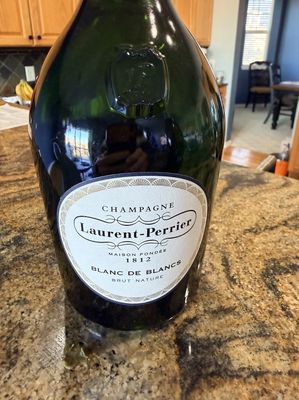
bubbles
Laurent-Perrier Blanc de Blancs Brut Nature
Laurent-Perrier
Vintage & Drinking Window
🍷
Drinking Window
2026-2035; the aggressive primary phase dominates now. A peak savory, autolytic plateau will emerge around 2029.
Perfect time to enjoy!
Vintage Notes
THIS VINTAGE: Though formally a Non-Vintage Champagne, the profile of this specific release leans heavily on reserve bases from 2016 and 2014. Treating this through a vintage lens reveals a compelling narrative. The 2016 growing season in Champagne was chaotic, fraught with devastating spring frost and crippling mildew, leaving growers in sheer panic. However, it concluded with a radiant, dry summer that miraculously salvaged the Chardonnay, delivering fruit with exceptional malic tension and concentration. This sharp 2016 tension is tempered by 40% reserve wines from 2014, a year marked by a gloomy summer but a spectacular, sun-drenched September. The 2014 base brings much-needed warmth, depth, and richness to the blend. In the regional context of Champagne, this multi-vintage approach is the only way a large house can successfully produce a zero-dosage Blanc de Blancs. Without the ability to blend the sharp, arrow-like acidity of 2016 with the broader, more forgiving shoulders of 2014, the final wine would be undrinkably tart. For buyers, this means the wine is highly drinkable now if you crave austerity, but it is not inherently collectible for decades. It is built for medium-term aging; the extreme primary tension will slowly evolve into nutty, savory autolysis by the early 2030s.
AI Confidence: 95%
$95.00 - $125.00 USD
93/100Outstanding
Sophie's Take
Listen to Sophie talk about Laurent-Perrier Blanc de Blancs Brut Nature
0:000:00
Grape Varieties
100% Chardonnay
Style: The structural foundation of this wine rests on an extreme expression of balance, or rather, the managed tension between zero residual sugar, high acidity, and 12.0% ABV. Without dosage, the wine relies entirely on 6 to 8 years of lees aging to generate enough textural body to prevent the acid from becoming overly shrill. Intensity is firmly medium; this is an articulate, arrow-like wine focused entirely on vertical cut rather than horizontal breadth. Length is medium-plus, carried by a persistent chalky salinity rather than fruit. Complexity is moderate but flawlessly integrated, weaving sharp citrus pith with maritime minerality. Typicity is explicit: it perfectly represents the taut, modernist Brut Nature movement in Champagne, deviating sharply from the opulent, brioche-driven profiles historically associated with prestige Blanc de Blancs. PEER COMPARISON: In the regional hierarchy, this sits in the upper-middle premium tier. Against Ruinart Blanc de Blancs, the Laurent-Perrier is vastly more articulate and driven, completely avoiding Ruinart's sometimes cloying sweetness. Compared to Agrapart Terroirs, it feels slightly less oxidative and more polished. However, Larmandier-Bernier's Longitude Extra Brut achieves a more profound, vinous texture through its oak usage, an element the stainless-steel-bound Laurent-Perrier lacks. TRADE-OFF PARAGRAPH: This is not a Champagne for those seeking the buttery, brioche-laden comforts of classic, dosed Blanc de Blancs. Buyers choosing this cuvee are trading approachability and mid-palate richness for skeletal tension and an unyielding, mineral-driven structure. If you prefer a more generous, fruit-forward style without sacrificing precision, Pierre Peters Cuvee de Reserve might serve you better at a similar price.
Alcohol: 12%
Tasting Notes
Aromatics: The nose opens with high-intensity tart green apple and white flowers, tightly bound by a chalk-dust minerality reflecting high acidity.
Mid-Palate: A light-to-medium body emerges with powdery lees influence, showing subtle oatmeal and lemon pith which offsets the absolute lack of dosage.
Palate Entry: Arrow-like and bracing, built on a spine of searing malic acidity that activates the salivary glands and dictates the presentation.
Texture: The mousse is fine yet aggressive, scrubbing the palate clean rather than coating it, enforcing the wine's lean, linear energy.
Finish: Concludes with medium-plus length and an oyster-shell salinity; a slight bitter almond limitation deters those seeking a plush resolution.
Visual: Pale, luminous gold in the glass with a fierce, continuous bead that immediately signals a high-tension structural profile.
Professional Ratings
Wine Spectator: 93/100
Robert Parker: 90/100
James Suckling: 95/100
Vinous: 94/100
Decanter: 92/100
Serving Recommendations
Temperature: 9-11 C (48-52 F)
Decanting: Do not decant. Allow 10-15 minutes in a wider tulip glass; at 15 minutes, the fierce zero-dosage tension slightly relaxes to unlock autolytic depth.
Food Pairing:
3. Scallop carpaccio (Classic: delicate raw sweetness of the scallop contrasts the zero-dosage tension).
5. Veal tartare with ginger (Unexpected: ginger amplifies the pithy bite while lean meat matches its weight).
6. Truffle-salted french fries (Unexpected: high acid and effervescence scrub the fat without sugar mud).
1. Fresh oysters with lemon (Classic: the wine's sheer acidity acts exactly like a squeeze of fresh citrus).
2. Sea bass crudo with lime and olive oil (Classic: the precision cuts cleanly through raw fish oil).
4. Chavignol goat cheese (Classic: high acid cheese perfectly matches high acid wine without clashing).
7. AVOID: Lemon meringue pie or fruit tarts (the complete lack of dosage makes the wine taste violently sour).
Winemaking & Vineyard
Production Notes:
IDENTITY & RECOGNITION: The Laurent-Perrier Blanc de Blancs Brut Nature is a 12.0% ABV, 100% Chardonnay non-vintage blend sourced from Champagne. Critics exhibit mild but telling disagreement on its severity. James Suckling leads with 95 points, lauding its velvety texture and a very dry finish. Vinous matches the enthusiasm at 94 points, while reviewers at Wine Spectator and Decanter praise its energetic citrus core with scores of 93 and 92 respectively. Conversely, Robert Parker's Wine Advocate issued a more reserved 90 points, calling it tightly meshed and noting it relies on a racy streak of minerality that some find austere. Jancis Robinson scored it a solid 16.5 out of 20. THE LEGEND: For a house historically defined by its reliance on Chardonnay, it is an astonishing fact that Laurent-Perrier waited until 2019 to release a 100% Chardonnay cuvee. The internal drama lay in the vision of the winemaking team, who refused to release a Blanc de Blancs with dosage, aiming to resurrect the zero-dosage legacy the house pioneered in 1889 with their Grand Vin Sans Sucre. The obstacle was raw material: it took nearly two decades to expand grower contracts and acquire the exact matrix of Grand Cru vineyards capable of delivering enough natural weight to survive zero dosage. While celebrated as a modernist triumph, prominent traditionalist critics have noted that this severe, uncompromising style deliberately abandons the plush, crowd-pleasing curves that built the house's original fortune. MARKET INTELLIGENCE: Trading between $95 and $125 USD, this bottle sits squarely in the premium non-vintage category. It is not an appreciating collectible, as non-vintage Champagnes rarely are, but it holds its value remarkably well as allocations remain relatively tight to ensure quality. The price trajectory is stable, avoiding the sharp inflationary hikes recently seen in cult grower Champagnes. At the asking price, this is a strictly specific acquisition. Honest verdict: A distinguished, razor-sharp 16/20 Champagne that perfectly executes its severe, zero-dosage mandate, making it a fair buy for purists who prioritize crystalline energy over comfort.
Vineyard Details:
TERROIR & CRAFT: The foundation of this Brut Nature lies in an exacting selection of Chardonnay from the Cote des Blancs (Avize, Cramant, Oiry, Chouilly) and the Montagne de Reims (Tours-sur-Marne, Villers-Marmery, Rilly-la-Montagne). The Montagne de Reims components are crucial here; grown on chalky subsoils with heavier topsoils, these eastern-facing vines yield the broader, more structured Chardonnay required to support a wine with no added sugar. The soils are predominantly deep Belemnite chalk, which provides the wine's intense, vibrating salinity. Vine ages average 30 years, utilizing 41B rootstocks designed to thrive in high-active calcium environments. In the cellar, the fruit is pressed gently to extract only the purest cuvee. Fermentation occurs exclusively in temperature-controlled stainless steel tanks to lock in absolute precision and primary energy, ensuring there is zero oak influence to hide behind. Full malolactic fermentation is allowed, an essential step to soften the brutal edges of the raw, high-acid Chardonnay. The wine is then aged extensively on its lees for a minimum of 6 to 8 years before disgorgement. The final dosage is 0g/L (Brut Nature), leaving the wine entirely naked and showcasing a production approach that is tightly allocated to preserve the exacting quality standards of the blend.
Awards & Accolades
• 90 Points - Robert Parker's Wine Advocate
• 95 Points - James Suckling
• 93 Points - Wine Spectator
• 92 Points - Decanter
• 94 Points - Vinous
• 16.5/20 - Jancis Robinson
Learn More
Explore Sophie's guides about this wine:
Fun Facts (1)
Sophie
Laurent-Perrier famously pioneered the "Brut Nature" category in Champagne back in the 1980s, and this expression contains zero added dosage—meaning no sugar whatsoever—yet somehow tastes beautifully balanced rather than punishingly austere, which is honestly quite the oenological flex.
Reviews (0)
No Reviews Yet
Be the first to review this wine!