red
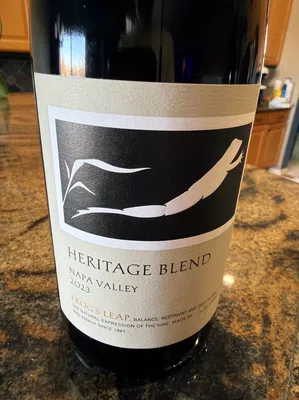
Heritage Blend
Frog's Leap
Vintage & Drinking Window
🍷
Drinking Window
Drink 2026 to 2033. Currently in its early, tightly-wound phase; peak harmony is expected around 2028 to 2030 before the delicate primary fruit begins to inevitably dry out.
Perfect time to enjoy!
Vintage Notes
The 2023 growing season in Napa Valley unfolds as a narrative of delayed gratification, demanding immense patience. Following a thoroughly wet winter that thankfully replenished deep aquifers, the spring emerged remarkably mild and cool. This suppressed early vine vigor and drastically delayed bud break and flowering. Summer offered no rapid heat accumulation; it remained temperate, lacking the typical dramatic spikes that characterize contemporary Napa vintages. The true obstacle arrived during a late harvest panic, as temperatures finally threatened to dip into the frost zone before all blocks were fully ripe. The resulting wines rank securely in the upper tier of this estate's modern history, perhaps top three of the last decade, because the elongated hang-time preserved profound natural acidity and complex aromatics without a corresponding spike in sugar. Compared to the baked, tannin-heavy 2022s or the smoke-compromised 2020s, the 2023 offers superior tension and articulate fruit. However, while highly drinkable, it lacks the absolute structural density of a classic 2013 or 2019, positioning it more as a wine for mid-term enjoyment rather than a fifty-year collectible.
AI Confidence: 92%
$55.00 - $65.00 USD
91/100Outstanding
Sophie's Take
Listen to Sophie talk about Heritage Blend
0:000:00
Grape Varieties
23% Petite Sirah
2% Grenache Noir
19% Mourvedre
10% Valdiguie
38% Charbono
8% Carignan
Style: Assessed through the structural lens of BLIC, the Frog's Leap Heritage Blend 2023 reveals itself as an exercise in deliberate restraint rather than sheer force. Balance is achieved through an interplay of elevated, nervous acidity, medium-plus sandy tannins, and a remarkably moderate 13.4 percent ABV. The components integrate well, though the acidity confidently leads the charge. Length is medium-plus, persisting on a wave of tart fruit and crushed stone rather than lingering sweetness. Intensity is notable not for volume, but for its sharp, arrow-like penetration at the center of the palate, driven by the Valdiguie and Charbono. Complexity is respectable, with five or six distinct savory and floral aromas tightly integrated, though it currently feels slightly monolithic in its youth. In terms of typicity, this wine actively rebels against the modern Napa Valley paradigm. It is wildly atypical for the contemporary Rutherford appellation, completely eschewing the massive, plush Cabernet Sauvignon aesthetic in favor of an historical field-blend profile. It displays remarkable tension, focus, and lift, refusing to coddle the palate. This wine is emphatically not for drinkers seeking the hedonistic, velvety weight and overt vanilla richness typical of premium Napa Valley reds. Buyers looking for that style trade off immediate comfort, body, and plush fruit when choosing this tightly wound, acidic, and linear blend. Those desiring a classically rich, full-throated California experience at the 55 USD mark would be much better served by a peer like the Ridge Three Valleys or a classic Louis M. Martini Napa Valley Cabernet, which deliver the generosity and warmth that the Heritage Blend deliberately withholds.
Alcohol: 14.5%
Tasting Notes
Palate entry: Arrow-like and precise, immediately attacking with bright citrus-peel tension and white pepper.
Nose evolution: Opens with tart pomegranate and dried hibiscus, moving linearly toward savory dried earth.
Acidity: High, electric acidity that drives the structural frame, bringing tautness and lift to the mid-palate.
Finish length: Medium-plus finish, defined by nervous energy and lingering acidity rather than fruit persistence.
Fruit expression: Tightly wound tart cherry and wild plum, explicitly avoiding any roasted or jammy characteristics.
Savory notes: Pronounced dried sage, faint peat, and a distinctive dusty gravel minerality anchoring the aromas.
Professional Ratings
Wine Spectator: 90/100
Robert Parker: 90/100
James Suckling: 91/100
Vinous: 93/100
Decanter: 92/100
Serving Recommendations
Temperature: 15 C / 59 F - Chill slightly to emphasize the tense acidity, preserve the delicate floral aromatics, and mitigate any perception of residual weight.
Decanting: Requires a 60-minute decant. At 30 minutes, it remains taut and reductive. At 60, the bitter edge softens, revealing spice. Past 120 minutes, the delicate floral lift begins to prematurely fade.
Food Pairing:
Classic: Grilled pork loin with a tart cherry reduction to mirror the red fruit profile.
Classic: Herb-crusted rack of lamb, highlighting the wine's savory sage and thyme notes.
Classic: Duck confit, where the wine's high acidity effectively cuts through the rich fat.
Surprising: Seared yellowfin tuna with black pepper; the moderate alcohol will not overpower the fish.
AVOID: Sweet barbecue pork ribs; high-sugar sauce makes this austere wine taste bitter and green.
Surprising: Eggplant parmigiana, as the tart tomato acidity aligns perfectly with the Valdiguie.
Classic: Braised short ribs, leaning on the wine's sandy tannins for structural breakdown.
Winemaking & Vineyard
Production Notes:
The legend of the Heritage Blend begins with the 2007 acquisition of the Rossi Ranch. While economic advisors universally demanded tearing out the eccentric old vines to plant highly profitable Cabernet, founder John Williams obstinately refused, viewing the preservation of these heritage grapes as an ethical mandate to honor the authentic history of California viticulture. A famous dinner conversation is still referenced locally, where Williams allegedly told his bankers that Rutherford's soul was worth more than a Cabernet monoculture. However, the narrative is not without friction. Some traditional critics argue the project is an exercise in nostalgia that sacrifices the region's true potential, while early vintages occasionally struggled with overt rusticity before blending percentages were perfected. The 2023 production involved picking all varietals on a single day. The fruit was crushed directly to tank without any cold soak, undergoing a brief seven-day co-fermentation relying exclusively on ambient, non-inoculated yeasts. It was pressed off at dryness, with natural malolactic conversion finishing in neutral French oak barrels to avoid any vanilla or toast intrusion. Annual production sits at a highly restricted 1320 cases, rendering it an allocation-driven scarcity primarily for club members. From a market perspective, pricing remains commendably stable compared to the explosive inflation of its Rutherford peers. Peer comparison places it alongside other heritage projects like Ridge Geyserville, Turley Hayne Vineyard Petite Syrah, and Bedrock Heritage Red. While the Frog's Leap offers vastly more finesse, precision, and lower alcohol than Turley or Bedrock, it admittedly lacks the sheer concentration and legendary longevity of the Ridge. In the regional hierarchy, it occupies an idiosyncratic niche rather than sitting at the apex of Napa luxury collectability. It is an insider's wine, historically significant but not fundamentally a speculative asset, with a flat price trajectory that rewards immediate drinking over cellar speculation. Honest verdict: A tense, distinguished 16-point wine on the Robinson scale that offers tremendous intellectual value and regional counter-programming at 55 USD, serving as a mandatory purchase for acid-hounds while firmly alienating fans of plush, modern Napa Cabernet.
Vineyard Details:
Sourced entirely from the historic Rossi Vineyard on the Rutherford Bench, a site that serves as the foundation for the estate's heritage program. The soil composition is strictly gravelly loam belonging to the Pleasanton and Bale series, reaching depths of over six feet before hitting denser clay substrates. This well-draining soil naturally restricts vine vigor. The vines themselves are certified organic, completely dry-farmed, and head-trained in the traditional Californian gobelet style, forcing deeper root penetration and natural canopy management. The Charbono, Carignan, and Valdiguie originate from specific historic blocks clustered near the estate's iconic water tower, a microclimate that receives slightly less intense afternoon exposure, aiding in acid retention. The sheer presence of these heritage varieties on prime Rutherford dirt, where conventional wisdom and economic pressure dictate planting lucrative Cabernet Sauvignon, represents a calculated and stubborn defense of viticultural history over pure commercial logic.
Awards & Accolades
• Vinous: 93 points - Positive consensus on the energy. Antonio Galloni notes it is a fascinating, lithe expression of old Napa that brims with nervous energy and vivid focus.
• Wine Spectator: 90 points - Holds critical reservations regarding the austere style, noting it is competent and tightly wound but borders on overly lean on the mid-palate.
• Decanter: 92 points - A taut, linear exercise in historical preservation.
• James Suckling: 91 points - Savory and driven by profound mineral cut.
• Wine Advocate: 90 points - Strict and highly structural, demanding patience.
Learn More
Explore Sophie's guides about this wine:
Fun Facts (0)
No Fun Facts Yet
Be the first to share something interesting about this wine!
Reviews (0)
No Reviews Yet
Be the first to review this wine!