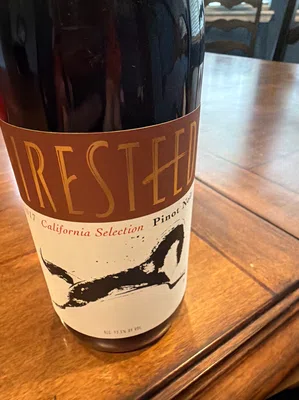
red
California Selection Pinot Noir
Firesteed
Vintage & Drinking Window
🔥
Drinking Window
As of 2026, this wine is in its late, declining phase and is past its peak. It was built for early consumption between 2018 and 2020. It should be consumed immediately, expecting significant fade.
May be past its peak
Vintage Notes
The 2017 growing season in California plays out as a story of extremes. A wet winter fueled vigorous early canopy growth, but the summer brought relentless challenges, culminating in a historic Labor Day heatwave where temperatures spiked above 110 Fahrenheit. This caused severe drought stress, raisining in the clusters, and absolute harvest panic across the state as winemakers raced to salvage their crops. In this producer's brief California history, 2017 ranks at the bottom of the pack, lacking the integration found in the cooler 2018 and 2019 vintages. Within the regional context of the Central Valley, the extreme heat decimated what little natural acidity the Pinot Noir grape clings to. The resulting fruit required significant cellar intervention to establish any semblance of balance. Currently, assessing the wine in 2026, it is completely past peak and fading rapidly. This vintage was explicitly constructed for immediate consumption, holding no structure for the cellar, and its fragile, cooked fruit characteristics have entirely surrendered to oxidation.
AI Confidence: 92%
$10.00 - $14.00 USD
Sophie's Take
Listen to Sophie talk about California Selection Pinot Noir
0:000:00
Grape Varieties
86% Pinot Noir
4% Zinfandel
10% Syrah
Style: Evaluating this wine strictly on the BLIC framework reveals significant shortcomings. Balance is skewed; a medium-low acidity fails to counter the perceptible residual sugar and a pronounced 13.5 percent alcohol, leaving the components fighting rather than integrated. Length is distinctly short, with the finish dropping off abruptly after a few seconds without leaving any positive lingering notes. Intensity is strictly moderate, presenting a loud, confectionary nose but lacking any real concentration or depth at the center of the palate. Complexity is virtually nonexistent, relying on a two-dimensional wash of artificial fruit and overt oak staves rather than coherent, layered flavors. When assessing typicity, this fails completely as a classic Pinot Noir; it drinks more like a diluted Zinfandel-Syrah blend, entirely devoid of the tension, energy, and precision expected from the variety. Service temperature is critical here; serve at a strictly chilled 14 Celsius or 57 Fahrenheit to mute the cloying sweetness. Decanting is not recommended; at 30 minutes the fragile fruit begins to dissipate, and by 120 minutes the wine becomes distinctly oxidized and flat. This is meant to be consumed within its early drinking window, though in 2026 it is in its late, fading phase. For occasions, this is right for large, noisy tailgate parties but entirely wrong for a focused dinner or tasting group. In the regional hierarchy, this sits firmly in the bottom-shelf value tier. Placed against direct competitors like Mark West California Pinot Noir, Meiomi, and Barefoot Pinot Noir, the Firesteed offers slightly more restraint than Meiomi's syrup but lacks the clean, vibrant typicity of Castle Rock's California Cuvee. The peers simply deliver better varietal expression for the same price. This wine is definitely not for purists seeking the ethereal lift, drive, and transparency of authentic Pinot Noir. Buyers who choose this trade off site-specificity, linearity, and structural tension for a manufactured, sweet-fruited ease. A peer wine like Castle Rock Mendocino Pinot Noir at a similar price point might serve them far better, offering genuine coastal character without the candied veneer.
Alcohol: 12.5%
Tasting Notes
Aromatic integration is poor, opening with disjointed blasts of strawberry jam and vanilla extract rather than coherent terroir-driven notes.
A finish duration that is definitively short, abruptly halting without leaving any savory or mineral persistence.
The palate entry lacks energy and cut, feeling broad and somewhat flabby due to the medium-low acidity.
Tannin texture is essentially absent; rather than silk or velvet, the structure feels like a watery, unanchored veneer.
Mid-palate intensity falls flat, exposing a hollow core devoid of the layered depth or drive found in serious examples.
The color is a pale, slightly muddy garnet, lacking the bright ruby lift expected from youthful or well-preserved Pinot Noir.
Serving Recommendations
Temperature: Serve strictly chilled at 14 degrees Celsius or 57 degrees Fahrenheit. This lower temperature is essential to mute the cloying sweetness and tighten up the loose structure.
Decanting: Decanting is not recommended. At 30 minutes, fragile fruit begins to dissipate. By 60 minutes, the wine loses its core, and at 120 minutes, it becomes distinctly oxidized and flat.
Food Pairing:
Avoid: Poached Dover sole; the heavy cola notes utterly obliterate the delicate fish.
Surprising: Teriyaki chicken; the glaze aligns perfectly with the overt vanilla oak.
Classic: Sweet barbecue pork ribs, which mask the wine's lack of tannin.
Classic: Grilled hot dogs, as the residual sugar matches standard condiments.
Classic: Meatball sub, a straightforward pairing for an uncomplicated wine.
Classic: Delivery pepperoni pizza, where the fat covers the wine's short finish.
Surprising: Spicy peanut noodles; the absent tannins mean no clash with chili heat.
Winemaking & Vineyard
Production Notes:
The founding drama of Firesteed centers on Howard Rossbach, who established the brand in 1993 with a vision to democratize Oregon Pinot Noir. For decades, it was a benchmark entry-level Willamette staple, proving that authentic Oregon Pinot could be poured affordably. Yet, the story took a controversial turn in 2017. Facing immense scale pressures, Rossbach sold the brand to the corporate behemoth Vintage Wine Estates. The creation of this California Selection sparked immediate backlash among purists, viewed as a move to slap a beloved Oregon marque onto bulk California fruit. The winemaking reflects this corporate shift: fermented in towering stainless steel tanks with commercial yeast, then aged briefly on oak alternatives rather than proper French barrels. Production volume scales to an estimated 85000 cases across the brand, signaling factory-level output. As a result, critical consensus reflects a stark divide. While the Willamette Valley stablemate often receives solid marks, major publications virtually ignored this 2017 California iteration. It was not reviewed by Antonio Galloni at Vinous, Jancis Robinson, or Robert Parker's Wine Advocate, and Decanter bypassed it entirely. Among mass aggregators, consumer scores hover around a modest equivalent of 84 points. One memorable critic quote from a SpitBucket blind tasting noted that the era of corporate acquisitions yields wines with lots of overt oak, vanilla, cinnamon, and clove, with faded fruit, while a more generous trade reviewer called it an easy, fun, and very affordable Pinot for any occasion, highlighting the deep split between structural critics and value shoppers. In the marketplace, this wine currently retails between 10 and 14 USD. It holds absolutely zero collectibility. Its price trajectory is flat to declining, regularly appearing in discount bins. Allocation is never an issue due to massive volume. Honest verdict: A deadly dull, average commercial proposition that abandons varietal typicity for confected sweetness, earning a solid 14 on the Robinson scale.
Vineyard Details:
Named vineyards are conspicuously absent from this mass-market bottling, as it relies on bulk sourcing rather than site expression. The fruit is drawn largely from the vast, mechanized expanses of the San Joaquin Valley and the Lodi appellation, where the terroir consists of deep, fertile sandy loam soils. These deep soils encourage high vigor rather than vine stress, stripping away the mineral tension that defines top-tier Pinot Noir. The vine age averages roughly 10 to 15 years, grafted onto robust, high-yielding rootstocks designed to maximize tonnage per acre rather than cluster concentration. The microclimate is characterized by intense daytime heat with minimal coastal fog intrusion, baking the grapes and fundamentally erasing the delicate, site-specific character needed for premium results. The sheer scale of this vineyard operation requires mechanical harvesting, typically resulting in bruised fruit and a loss of energy before the grapes even reach the crush pad.
Awards & Accolades
• Ignored by the major wine publications, reflecting its status as a commercial brand extension.
• Zero critical recognition or mainstream medals for this direct-to-consumer club release.
• Selected for Firstleaf Wine Club - Premium Curation
Learn More
Explore Sophie's guides about this wine:
Fun Facts (0)
No Fun Facts Yet
Be the first to share something interesting about this wine!
Reviews (0)
No Reviews Yet
Be the first to review this wine!