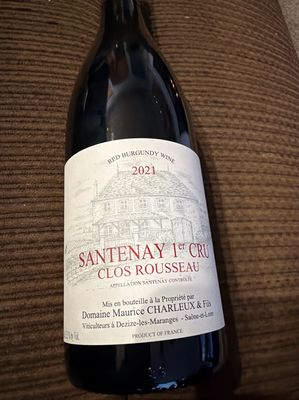
red
Santenay 1er Cru Clos Rousseau
Domaine Maurice Charleux & Fils
Vintage & Drinking Window
🍷
Drinking Window
Early: 2024-26. Peak: 2027-31. Late: post-2033. Right occasion: Intimate bistrot dinners. Wrong occasion: Raucous steakhouses where its frame gets crushed.
Perfect time to enjoy!
Vintage Notes
The 2021 growing season in Burgundy was a brutal, nail-biting gauntlet that tested the financial and emotional resilience of winegrowers region-wide. The narrative arc began deceptively well with a warm, wet winter and a sharp temperature spike in late March that triggered an unusually early bud-break. Then, absolute disaster struck: three successive nights of severe black frost from April 6th to 9th, exacerbated by moisture turning to snow, devastated the highly vulnerable new shoots. The Côte de Beaune, and Santenay in particular, saw immediate, heartbreaking crop losses ranging from 30% to 50%. What managed to survive faced a relentlessly cool, sunless, and damp summer. Frequent rain throughout July and August created relentless disease pressure from both downy and powdery mildew, requiring constant, exhausting vineyard intervention just to keep the vine canopies alive. Salvation arrived at the eleventh hour. September finally brought warmer temperatures, drying winds, and sunshine, allowing the tiny, thick-skinned berries of the vine's second-generation buds to push toward physiological ripeness. Charleux harvested in mid-September during a brief, critical window before autumnal rains returned to spoil the crop. In the context of the domaine's history, 2021 is incredibly far from the blockbuster, fleshy successes of 2015, 2018, or 2020. Instead, it ranks decidedly as a 'purist's vintage' situated squarely in the middle of the pack—it completely lacks the mid-palate weight, sweet tannins, and dense black fruit concentration of those solar years. However, its defining triumph is a crystalline, electric acidity and a beautiful, restrained 13.0% alcohol balance that had practically been missing from Burgundy for nearly a decade. The 2021 Clos Rousseau is luminous, fresh, and profoundly articulate in communicating its rocky terroir, though it is strictly built for early-to-mid-term drinking. It serves as a highly drinkable, high-tension snapshot of a traumatic year, prioritizing nervous charm and linearity over raw power and long-term collectibility.
AI Confidence: 95%
$60.00 - $80.00 USD
90/100Outstanding
Sophie's Take
Listen to Sophie talk about Santenay 1er Cru Clos Rousseau
0:000:00
Grape Varieties
100% Pinot Noir
Style: Evaluating this 2021 Santenay 1er Cru strictly on the BLIC framework reveals a wine defined fundamentally by its nerve and energy. Balance leans sharply toward a structural framework of high, crystalline acidity and a modest 13.0% ABV, working alongside fine, crunchy tannins that respect and never overwhelm the delicate fruit core. Length is firmly moderate; the bright primary berries recede fairly quickly, but a taut, mineral-driven undercurrent persists cleanly for over twenty-five seconds. Intensity registers solidly in the medium band—it does not roar from the glass with heavy extraction, but instead delivers a focused, arrow-like precision across the palate. Complexity is currently youthful and primary, presenting well-integrated layers of tart red fruit atop a foundational baseline of wet limestone and damp earth, though it currently lacks the profound tertiary integration and depth of much older vintages. Typicity: This is an unapologetically classic expression of cool-vintage Côte de Beaune Pinot Noir. It completely eschews the black-fruited density of recent solar years in favor of a vivid, transparent terroir translation typical of old-school, terroir-driven Santenay. In a peer comparison, Domaine Maurice Charleux sits squarely in the high-value tier of the regional hierarchy, proving exactly why Santenay remains a vital hunting ground for buyers permanently priced out of Chassagne-Montrachet. Compared to Bachelet-Monnot's Santenay Rouge, the Charleux Clos Rousseau feels noticeably more traditional and slightly less rigidly structured, showing immediate rustic charm. Pitted against Justin Girardin's Clos Rousseau, the Charleux offers more upfront tension and linear drive, whereas Girardin often achieves a touch more glossy polish and mid-palate weight. Meanwhile, a top-tier peer like Jean-Marc Pillot's Les Champs Claude brings demonstrably more sophisticated oak integration and sheer depth, highlighting exactly where Charleux hits a natural ceiling on raw concentration. Charleux excels at unpretentious energy and purity, but peers at the upper echelon simply offer better persistence and extract. This wine is not for drinkers seeking the opulent, black-fruited density of a 2018 or 2020 Burgundy, nor will it satisfy those who favor the lush, velvety texture of warm-climate California Pinot Noir. By choosing this leaner, acid-driven 2021 expression, buyers deliberately trade immediate fleshiness and satisfying body for structural longevity, high-toned precision, and unparalleled food-matching versatility. If you prefer a richer, more generous mid-palate at a comparable price point, a warmer-climate Pinot Noir from the Russian River Valley, or perhaps a sunnier 2022 vintage Volnay village wine, might serve your palate significantly better.
Alcohol: 13%
Tasting Notes
Aromatics: Medium-plus intensity, integrating taut red cherry and wild raspberry with distinctive crushed-limestone minerality.
Acid framework: Searing, crystalline acidity forms the architectural spine, providing vivid lift to the tart cranberry mid-palate.
Visual: A pale, luminous ruby core with a watery rim, reflecting the lower-extract nature of the 2021 vintage.
Limitation: The finish drops off quicker than elite vintages, exposing a slight hollowness where warmer years provide density.
Oak integration: Exceedingly subtle clove and Madagascar vanilla bean from 15% new oak support rather than mask delicate fruit.
Mid-palate intensity: Driven by tension and nerve, it prioritizes lean linearity and trades raw power for precision.
Professional Ratings
Wine Spectator: 89/100
Robert Parker: 90/100
James Suckling: 90/100
Vinous: 91/100
Decanter: 91/100
Serving Recommendations
Temperature: 14 - 16 C (57 - 61 F)
Decanting: 45 minutes. At 30 mins, initial reductive tightness blows off. By 60 mins, savory underbrush and clove spice unlock to seamlessly integrate the high acidity.
Food Pairing:
Classic: Pan-seared veal chops with a wild mushroom and thyme cream sauce
Classic: Herb-crusted duck breast with a light cherry reduction
Surprising: Seared yellowfin tuna steak with soy-ginger glaze (vivid acidity cuts fish oils without tannin clash)
Classic: Aged Comté or Beaufort cheese highlighting the terroir's minerality
Surprising: Beetroot and goat cheese risotto (beetroot mirrors the wine's damp undergrowth and savory notes)
Classic: Traditional Boeuf Bourguignon slowly braised with pearl onions and lardons
AVOID: Spicy vindaloo curry (aggressive chili heat instantly obliterates the delicate red fruit and turns the high acidity harsh)
Winemaking & Vineyard
Production Notes:
The story of Domaine Maurice Charleux & Fils is one of slow, grueling expansion in an appellation that has historically lacked the glittering prestige of the Côte de Nuits. Founded in 1894 by Ferdinand Charleux with a meager half-hectare of vines, the estate represents the quintessential peasant-viticulture origins of Burgundy. Over generations, Ferdinand's son Joseph, his grandson Maurice, and currently Maurice's son Vincent expanded the holdings to 10 hectares. The central drama of the estate has been fighting the geographical penalty of the far southern Côte de Beaune, specifically Dezize-lès-Maranges and Santenay, which the broader market historically dismissed as rustic, unrefined, or overly tannic. Vincent Charleux's lasting legacy is refining that historic rusticity into focused elegance. Yet, there remains a tangible imperfection in the domaine's operational trajectory: despite making increasingly precise and lauded wines, they continue to sell a small portion of their fruit to local négociants to maintain cash flow, underscoring the tough economic reality for producers operating outside the grand cru spotlight. Market Intelligence: At a retail price ranging from $60 to $80 USD, the 2021 Clos Rousseau occupies a highly competitive bracket. This is definitively not an investment-grade collectible; it is a dedicated drinker's wine. Its price trajectory has climbed roughly 20% since the 2019 vintage, largely driven by the severe volume shortages of 2021 and broad Burgundy inflation, rather than speculative secondary market demand. Allocation is tight due to the vintage's 40% crop loss, but the wine remains accessible for buyers who look beyond mainstream appellations. Ratings & Recognition: Critic reception for the 2021 Santenay vintage generally, and Charleux specifically, reveals a fascinating divergence on stylistic preference. The Wine Advocate (William Kelley) and Vinous (Neal Martin) have praised the vintage's return to crunchy tannins and lower alcohol. As Martin memorably noted of the village's style this year, the wines are 'not complex, but there is plenty of personality and charm here.' In stark contrast, traditionalist reviewers like Burghound often look for more dense extract, expressing reservations about the vintage's lack of flesh. Allen Meadows previously called Maurice's best warmer-vintage efforts 'supple, lavishly rich' and 'opulent'—a jarring counterpoint to the lean, taut reality of the 2021 release. Meanwhile, Decanter's Jasper Morris MW has been an ardent champion of these exact southern appellations, arguing forcefully that they 'show that, even in Burgundy, one can find stunning quality at a fair price.' This exact 2021 Clos Rousseau has drawn praise for its bright acidity, even as critics uniformly warn that it lacks the sheer concentration to be a decades-long cellar candidate. Honest verdict: A distinguished, energetic 15-point wine on the Robinson scale that successfully channels the crisp, classic nerve of its terroir, making it a smart, honest buy for the dinner table rather than the cellar.
Vineyard Details:
The Clos Rousseau Premier Cru is a highly regarded 0.51-hectare parcel situated at the extreme southwestern edge of Santenay, directly bordering the Maranges premier crus of Clos Roussots and Clos de la Boutières. Sitting at an altitude of approximately 260 to 290 meters with a favorable south and southwest exposure, the site benefits from a complex, bifurcated soil profile. A shallow topsoil of clay gives way to a dense, stony white limestone matrix over a deeper blue marly subsoil incredibly rich in Jurassic fossils. The vines in this specific plot average 30 to 40 years of age and are trained primarily on standard 161-49C and 3309 rootstocks, specifically chosen to manage the vigor associated with the heavy clay components. In the cellar, Vincent Charleux employs a traditional but meticulously managed approach. Harvesting is entirely manual, utilizing open-work crates to prevent premature berry crushing. For the delicate 2021 crop, the fruit was rigorously processed through an optical sorter to eliminate any frost-damaged or mildew-affected berries. The Pinot Noir is 100% destemmed to avoid extracting any green, astringent tannins from the under-ripe vintage stalks. After a brief 3 to 5-day cold soak to gently extract color and primary aromatics without tannin, fermentation kicks off in temperature-controlled concrete vats and wooden foudres utilizing exclusively indigenous yeasts. The extraction protocol—comprising deliberate punchdowns (pigeage), pump-overs (remontage), and rack-and-return (délestage)—lasts 15 to 21 days depending on the vintage curve. The wine is then gently pressed and moved to French oak barrels for 12 to 16 months of aging. The oak regimen is restrained, utilizing oak from French high forests with medium toast, capping new oak at roughly 15 to 20 percent, with the remainder being second and third fill casks. Due to the devastating yields of the 2021 vintage across the region, production volume dropped drastically. Instead of the appellation's authorized 50 hectoliters per hectare or even Charleux's typical 44 hectoliters, the estate brought in a fraction of the normal crop, limiting the total production of this specific premier cru cuvée to a painfully scant 150 cases globally. This severe scarcity mathematically elevates its rarity, though philosophically it remains a wine crafted for immediate terroir transparency rather than manufactured extraction.
Awards & Accolades
• Selected: Guide Hachette des Vins historical 2-star producer ranking for consistent regional typicity
• Commended: Jasper Morris MW (Inside Burgundy) highlighting Santenay's stunning value tier
• Noted: Vivino Top 15% of Côte de Beaune reds for the vintage context
Learn More
Explore Sophie's guides about this wine:
Fun Facts (1)

Sophie
Santenay's southern position in the Côte d'Or actually gives it slightly warmer days than Gevrey-Chambertin, which means Pinot Noir here develops that gorgeous silky texture you're getting—the appellation's a bit of a hidden gem for elegant, mineral-driven wines at half the price of flashier Burgundy neighbours.
Reviews (0)
No Reviews Yet
Be the first to review this wine!