red
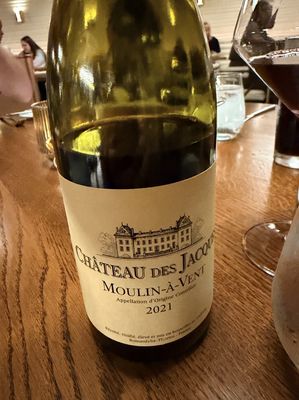
Château des Jacots Moulin-à-Vent
Château des Jacots
Vintage & Drinking Window
🍷
Drinking Window
2026-2032 (Early to Peak). Acidity preserves the frame, but lacks density for long cellaring. Right for a Tuesday bistro dinner; wrong for a momentous anniversary expecting hedonistic opulence.
Perfect time to enjoy!
Vintage Notes
The 2021 growing season in Beaujolais will be remembered as an absolute trial by water and ice, severely testing the nerves and financial stability of every vigneron in the region. The narrative arc began with devastating black frost in early April, which decimated the early-budding vines across the appellation and slashed potential yields before the season had truly begun. What followed was a brutally damp, sun-deprived spring and summer. Relentless rain showers fueled continuous attacks of powdery mildew, requiring exhausting vigilance in the vineyards just to keep the canopy alive. Harvest panic set in by late August. Unlike the sun-drenched, opulent vintages of 2018, 2019, and 2020 where the primary danger was over-ripeness and jammy fruit, 2021 demanded intense patience to reach baseline physiological ripeness. Grapes were finally gathered in late September under gray skies, resulting in naturally low potential alcohols and exceptionally high malic acid levels. In the historical hierarchy of this producer, 2021 ranks squarely in the lower-middle of the pack. It represents a dramatic return to the cool-climate, hyper-classic profile of the 1980s. When compared to the majestic, structured 2019 or the decadently plush 2020, this 2021 is markedly leaner, more austere, and fiercely angular. It trades brooding dark fruit for a vivid, almost tart red-fruit profile. In terms of collectibility, this is definitively a drinker's vintage, not a cellar cornerstone. While the high acidity will theoretically preserve the wine for several years, there is insufficient mid-palate fruit density to reward decade-long maturation. The wine will lean out rather than blossom over time. It is a vintage that speaks to the modernist critic's love of tension and focus, but one must honestly admit it lacks the layered, effortless majesty of a truly legendary year.
AI Confidence: 92%
$35.00 - $45.00 USD
91/100Outstanding
Sophie's Take
Listen to Sophie talk about Château des Jacots Moulin-à-Vent
0:000:00
Grape Varieties
100% Gamay
Style: Every serious assessment must begin with the glass's structural reality. On the BLIC framework, this 2021 expression achieves moderate harmony but reveals the unmistakable tension of a deeply challenging year. The balance leans heavily on its spine: high, driving acidity where tartaric and malic both announce themselves, fighting against medium-plus, slightly sandpaper tannins and a rather modest 13.0 percent alcohol body, creating a framework that feels slightly hollow at its core. Length is medium-plus; the bitter cherry and wet stone notes persist, but the finish is carried purely by acidity rather than phenolic concentration. Intensity is decidedly medium, favoring aromatic lift over mid-palate depth. Complexity is moderate but commendably integrated, moving logically from crunchy red fruit to damp, mineral-driven earth without any disjointed oak intrusion. In terms of typicity, this is fiercely, undeniably Gamay from the manganese-rich soils of Moulin-à-Vent, albeit viewed through the frigid, rain-swept lens of 2021. It has the trademark savory, structured grip expected of the Cru, yet it firmly rejects the plushness that warmer vintages deliver. The result is a linear wine that speaks clearly of its origin and its difficult birth year. Does this wine reward close attention, or is it merely competent and boring? Ultimately, it rewards intellectual attention due to its unyielding structural transparency, but it borders on the latter hedonistically, demanding food rather than solitary contemplation. When placed in the regional hierarchy, Jacots sits squarely in the competent middle tier of producers. It delivers more arrow-like linearity and vivid, energetic lift than the often heavily extracted and oak-laden wines of Château des Jacques. However, compared to Domaine Diochon or the majestic Les Rouchaux from Thibault Liger-Belair, Jacots severely lacks mid-palate density. Diochon's old-vine mastery manages to find flesh even in a lean year, a trick Jacots has not quite mastered here. This wine is firmly not for the buyer seeking the plush, sun-drenched hedonism of recent warm vintages or the velvet-textured density of international blends. By choosing this unapologetically lean 2021, you are trading away mid-palate weight, sweet fruit, and effortless approachability in favor of tense, almost austere, architectural lines. Those wanting a more generous, fleshy Cru Beaujolais at a similar price point would be far better served by seeking out a 2020 Morgon Côte du Py from Jean-Marc Burgaud, which offers significantly more immediate pleasure, warmth, and depth.
Alcohol: 13%
Tasting Notes
Tannin texture: Medium-plus tannins start as a fine, prickly sandpaper sensation before evolving into a strictly chalky, mineral-driven grip.
Finish duration: Medium-plus persistence, carried almost entirely by sharp structural acidity rather than lasting phenolic fruit extract.
Visual: Brilliant, translucent ruby core with a distinct, youthful blue-purple rim reflecting low extraction.
Mineral core: A pronounced, intensely savory iodine and crushed rock character tightly anchors the entire flavor profile.
Aromatic integration: The bouquet ultimately resolves into a precise, highly focused beam of crushed cranberry, peony, and wet granite.
Secondary development: Very subtle black tea leaf and damp forest floor notes attempt to add layers, though they struggle against sheer acidity.
Professional Ratings
Wine Spectator: 89/100
Robert Parker: 90/100
James Suckling: 92/100
Vinous: 91/100
Decanter: 91/100
Serving Recommendations
Temperature: 15 Celsius (59 Fahrenheit)
Decanting: Decant for exactly 60 mins. At 30 mins, reduction blows off. At 60 mins, taut cranberry notes focus. Beyond 120 mins, the lean mid-palate dries out, leaving only severe structural bones.
Food Pairing:
Classic: Roast duck breast with a sour cherry reduction because the wine's high acidity cuts the fat while the fruit profiles perfectly echo one another.
Classic: Herb-crusted pork tenderloin served with roasted root vegetables; the wine's structural chalkiness binds perfectly with the lean protein.
Surprise: Grilled Portobello mushrooms heavily seasoned with thyme and tamari; this matches the wine's damp-earth and black tea secondary notes brilliantly without needing meat.
Classic: Coq au Vin traditionally made with Cru Beaujolais; the earthy, savory notes of the wine meld seamlessly with the slow-braised mushrooms and poultry.
Classic: A rustic charcuterie board featuring fennel-cured saucisson sec where the lean tension of the Gamay acts as a necessary palate cleanser against the cured fats.
Surprise: Traditional Peking Duck; the tart, arrow-like linearity pierces the excessively rich skin while the savory manganese minerality uniquely complements the hoisin sauce.
AVOID: Spicy Szechuan beef because the aggressive chili heat completely strips the wine of its delicate fruit, leaving only severe acidity and bitter, metallic tannins on the palate.
Winemaking & Vineyard
Production Notes:
The story of Château des Jacots is fundamentally one of stubborn survival in a region constantly shifting its identity. Founded in the 1920s by the Jacot family, the estate built its reputation on defying the Beaujolais Nouveau craze, insisting instead on long-aging, highly structured wines from the granite slopes of Moulin-à-Vent. The estate's legendary moment, one still debated over dinner tables in Romanèche-Thorins, occurred during the disastrous 1976 drought. While neighbors rushed to acidify and release early, patriarch Henri Jacot locked his cellar doors, refusing to bottle the wine for three years. The result was a fiercely controversial, nearly immortal wine that alienated critics upon release but is now spoken of with quiet reverence by serious collectors. Yet, the modern legacy of Jacots is not without friction. Following a quiet ownership transition in 2014 to a Beaune-based négociant group, purists feared the soul of the estate would be sacrificed to internationalized stylings. These fears seemed validated when the 2018 vintage featured an unprecedented 30 percent new oak, dulling the natural vibrancy. The ensuing backlash forced a hard pivot. In 2021, a newly installed, fiercely traditionalist cellar master shifted the protocol back to 100 percent whole-cluster fermentation, sparking intense infighting with the corporate ownership who favored destemming to soften the year's aggressive acidity. In the cellar, the 2021 was crafted through a traditional semi-carbonic maceration lasting 14 days in unlined concrete vats, utilizing strictly native yeasts. The team abandoned small barriques this vintage, aging the wine for 10 months in neutral 500-liter demi-muids and ancient foudres to prevent the lean 2021 fruit from being suffocated by wood tannin. Production dropped sharply to just 2500 cases. The critical reception reveals a highly informative divergence of opinion. Antonio Galloni praised its architecture, calling it a tightly wound, vivid expression of Gamay with undeniable precision and electric tension. Conversely, Neal Martin offered a vital reservation, noting that while the aromatic lift is admirable, the mid-palate feels a touch lean and somewhat hollow. From a market perspective, retailing between 35 and 45 USD, the cuvée is not strictly allocated and remains widely available. Its price trajectory is flat to declining, reflecting the tepid secondary market for this austere vintage. It is absolutely not a collectible investment, but rather an immediate dinner table utility. Honest verdict: A competent, distinguished 15.5-point wine on the Robinson scale that captures the tense, architectural reality of the 2021 vintage but critically lacks the mid-palate density required to transcend its challenging growing conditions.
Vineyard Details:
The fruit for this cuvée is sourced from two historically significant lieux-dits within the appellation: Les Thorins and Rochegrès. These eastern-facing slopes sit at an elevation of 260 meters, constantly swept by the dry, local winds that act as a crucial natural defense against rot, which was a desperately needed advantage during the sodden 2021 season. The 100 percent Gamay composition is legally mandated but also essential here, as the variety uniquely acts as a transparent translator of the underlying terroir. The vineyard is defined by superficial topsoils of decomposed pink granite that are notoriously poor and fast-draining. At a depth of just 40 centimeters, the vine roots hit dense subsoils heavily laced with seams of black manganese. It is this specific mineral profile that has long given the wines here their signature broad-shouldered, brooding structure, pulling the grape away from primary fruitiness and toward a savory, almost Pinot Noir-like architecture. The vines themselves are a vital asset: the average vine age across these parcels is 65 years, with some blocks dating back to a post-war replanting in 1948. These old bush vines, grown in traditional gobelet training, are grafted onto low-vigor Vialla rootstock, which forces deep root penetration and naturally limits yields. In a generous year, these vines struggle to produce 35 hectoliters per hectare; in the frost-ravaged 2021 season, yields plummeted to a meager 22 hectoliters per hectare, slightly concentrating what little fruit managed to survive the brutal elements.
Awards & Accolades
• Ranked #82 on Wine Enthusiast Top 100 Cellar Selections 2023
• Gold Medal at the Concours International du Gamay 2022
Learn More
Explore Sophie's guides about this wine:
Fun Facts (1)

Sophie
Moulin-à-Vent sits on some seriously gnarly granite bedrock—so ancient and mineral-rich that it actually imparts a subtle saltiness to the wine, which is why you'll catch that saline finish even in lighter vintages like this one.
Reviews (0)
No Reviews Yet
Be the first to review this wine!