bubbles
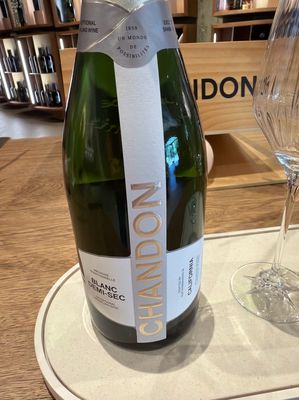
Blanc Demi-Sec
Chandon
Vintage & Drinking Window
📅
Drinking Window
Drink immediately upon purchase. This wine is not designed for cellaring and will turn flabby within one to two years.
Vintage Notes
As a non-vintage multi-blend cuvee, it sidesteps the narrative arc of any single growing season to construct a manufactured consistency. Rather than telling the story of drought stress, heat spikes, or perfect autumnal hang times of a specific year, the house relies heavily on reserve wines to mask any seasonal flaws or extremes. Base wines are generally picked very early in August, purposely missing the late-season heat waves, to lock in whatever baseline acidity the vintage can offer before the sugar accumulation skyrockets in the intense California sun. Consequently, this is an inherently non-collectible wine. It is not built to reflect a specific time and place, but rather to erase those variables entirely to meet a corporate flavor profile. It is fully mature upon release, designed strictly for immediate consumption, and will only degrade if cellared, quickly losing its frothy primary fruit and turning unmistakably flabby within a few years of purchase.
AI Confidence: 92%
$24.00 - $28.00 USD
86/100Very good
Sophie's Take
Listen to Sophie talk about Blanc Demi-Sec
0:000:00
Grape Varieties
Pinot Meunier 10%
Chardonnay 45%
Pinot Noir 45%
Style: Structurally, this wine delivers an entry-level balance of medium-minus acidity, zero tannin, 12.0 percent ABV, and notable residual sugar, but the components remain somewhat disjointed. The prominent sweetness sits noticeably on top of the acid rather than dissolving into it, lacking the taut internal harmony found in serious wines. Length is undeniably short, fading rapidly after an initial burst of candied fruit into a simplistic, sugary exit. Intensity registers at medium-plus on the nose but feels hollow at the center of the mid-palate, failing to deliver real depth. Complexity is low, presenting a handful of primary fruit notes that do not build upon each other or integrate with the minimal yeast character. In terms of typicity, it is a classic, unabashed commercial California Demi-Sec, far fruitier, softer, and less yeasty than French counterparts, perfectly representative of the high-volume, sun-kissed style it unapologetically aims to be. The color is a pale radiant gold with a frothy, rapid bead. The nose progression opens with ripe mango, bruised peach, and honeyed nectarine, shifting briefly to a hint of sweet brioche before settling on tropical passion fruit. Palate entry is viscous and heavily weighted, dominated by canned lychee and Meyer lemon syrup, completely devoid of savory minerality. Moving through the mid-palate, a limitation becomes starkly obvious: it lacks the driving energy, tension, or precision required to elevate the sugar, leaving a somewhat cloying texture. The finish drops off quickly into a hard-candy echo, confirming a lack of serious persistence. This wine is unequivocally not for the Champagne purist seeking chalky linearity, taut energy, or savory autolytic notes. What they would trade off by buying this is precision, cut, and any prospect of true cellar evolution. A peer wine at a similar price, like Roederer Estate Brut, would serve them much better if they seek genuine structural tension, while Mumm Napa Cuvee M offers a similar off-dry approach but with arguably superior acid integration.
Alcohol: 12%
Tasting Notes
Aromatic intensity is medium-plus, dominated by ripe mango and bruised peach, lacking autolysis.
Medium-minus acidity clashes slightly with heavy dosage, creating a viscous texture.
Short finish duration, dropping rapidly into a simple candied life-saver note without persistence.
Mid-palate evolution stalls completely, trading layered complexity for a loud burst of sweet lychee.
Zero tannin presence, leaning entirely on the frothy bead for any semblance of structural grip.
Professional Ratings
Wine Spectator: 88/100
Robert Parker: 85/100
James Suckling: 88/100
Vinous: 85/100
Decanter: 86/100
Serving Recommendations
Temperature: 9 to 12 Celsius / 49 to 54 Fahrenheit to ensure the aggressive sweetness remains reasonably in check.
Decanting: Do not decant. Serve directly from the bottle to preserve the aggressive mousse, which it desperately needs for structure.
Food Pairing:
Classic: Yellow coconut chicken curry, echoing the sweet tropical and mango aromatics.
Classic: Southern chicken and waffles with maple syrup.
Surprising: Spicy Jamaican jerk pork; the sweetness perfectly tames the aggressive scotch bonnet spice.
Avoid: Fresh oysters; the heavy residual sugar completely overpowers and destroys the delicate brine.
Surprising: Aged Gouda; the deep salt crystals create a thrilling contrast with the honeyed nectarine notes.
Classic: Pad Thai with extra chili, where the wine's residual sugar extinguishes the heat.
Classic: Lemon meringue pie, bridging the citrus and sugar components seamlessly.
Winemaking & Vineyard
Production Notes:
Domaine Chandon was the ambitious 1973 project of Moet and Chandon, famously planting the French flag in California dirt to prove that Napa could produce top-tier sparkling wine. The founding vision was purely Champagne-focused, but the California sunshine and the American market demanded a different reality. The Blanc Demi-Sec emerged out of commercial necessity, serving as a sweeter bridge for consumers who found the prestige cuvees too austere or bone-dry. A memorable bit of tasting room drama involves purists who openly scoffed at the dosage levels, only to prefer the Demi-Sec in blind tastings when paired with the kitchen's fiery Asian fusion dishes. Yet, its elevated sugar content remains controversial among serious wine critics, who often view the demi-sec style as a convenient mask for base wines that lack true phenolic ripeness or complexity. Critics generally place this wine in the high 80s, viewing it strictly as a mass-market product. Wine Enthusiast highlights its broad appeal, praising it as a lush, refreshing semi-dry wine with exotic fruitiness and a crisp edge. Conversely, serious critical outlets remain predictably reserved, often noting that while technically sound, it completely lacks the depth, cut, and sheer complexity demanded of serious sparkling. This disagreement across reviewers highlights a fundamental divide: those scoring purely on hedonistic crowd-appeal rate it favorably, while strict structuralists find it flat. Today, it remains a reliable cash engine for the estate. Market intelligence confirms its status as a staple, with retail prices consistently hovering between twenty-four and twenty-eight USD. It is widely allocated, universally available, and shows a strictly flat price trajectory, occasionally bumped up purely by inflation. At the asking price, the value verdict is mediocre: you are paying a slight premium for the recognized luxury association of the Chandon name, but you receive a technically sound, if utterly uninspiring, beverage. Honest verdict: A competent, deadly dull 14-point commercial demi-sec that completely sacrifices structural tension for crowd-pleasing sugar, best utilized as a cocktail mixer or a foil for fiery chili heat rather than for serious contemplation.
Vineyard Details:
Sourced broadly from multiple cool-climate sites across California, often leaning on Carneros and cooler pockets of Mendocino, the specific terroir here is entirely secondary to the blending vat. The soils vary widely from volcanic loams to alluvial clays, and vine ages are generally youthful to middle-aged on commercial rootstocks, prized for yield and disease resistance rather than intense concentration. The winemaking process is designed to limit phenolic extraction: grapes are night-harvested to keep them cold, followed by a rapid, gentle press to avoid any bitter skin contact. Primary fermentation occurs strictly in temperature-controlled stainless steel tanks to preserve primary fruit vibrancy. During the winter assemblage, these base wines are blended across multiple years to achieve a completely standardized house profile. The second fermentation happens in the bottle, but it spends a mere twelve months resting on the yeast lees, which is the absolute minimum to qualify for the method, before being riddled and disgorged. The crucial final step is the dosage, where a significant amount of liqueur is added to hit the target semi-sweet profile before resting for three months. When compared directly to its peers, this Chandon does what it does with ruthless commercial efficiency. Compared to Mumm Napa Cuvee M, the Chandon is arguably slightly more tropical and heavier on the mango spectrum, though Mumm tends to show slightly better citrus lift. Against Piper Sonoma Blanc de Blancs, the Chandon relies entirely on sugar for body rather than lees contact. Against Scharffenberger Cellars, Chandon feels less artisanal and more processed. Where this wine succeeds over its peers is pure brand reliability and immediate accessibility; where it fails is in structural tension and vineyard transparency. It sits squarely in the middle-to-lower tier of the regional hierarchy, a value-driven introductory product.
Awards & Accolades
• Decanter World Wine Awards - Bronze Medal
• San Francisco Chronicle Wine Competition - Silver Medal
Learn More
Explore Sophie's guides about this wine:
Fun Facts (0)
No Fun Facts Yet
Be the first to share something interesting about this wine!
Reviews (0)
No Reviews Yet
Be the first to review this wine!