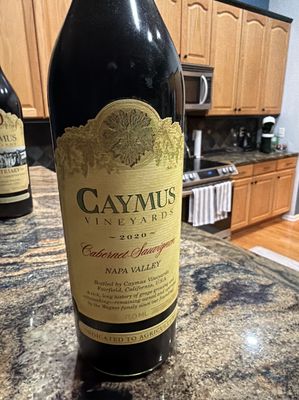
red
Cabernet Sauvignon
Caymus Vineyards
Vintage & Drinking Window
🍷
Drinking Window
Drink now through 2028. Currently in its peak early-drinking phase; do not hold for a late phase, as it lacks acidity to survive.
Perfect time to enjoy!
Vintage Notes
The 2020 growing season in Napa Valley was a trial by fire. It began promisingly with warm, consistent ripening weather, but late August brought the catastrophic LNU Lightning Complex fires, followed swiftly by the Glass Fire in September. Rampant smoke taint forced hundreds of premium producers to completely abandon their red wine harvests. Amidst this regional harvest panic, the producer leveraged its massive cross-valley scale, sourcing fruit early and dodging the worst of the smoke on the valley floor to bottle over 140,000 cases. In the pantheon of the estate's vintages, 2020 sits firmly in the middle of the pack; it lacks the freshness of 2019 or the structural integrity of 2013, though intense cellar intervention smooths over most vintage variations. This is strictly a drink-now proposition. The soft acidity profile and extreme ripeness render it entirely unsuited for cellaring, and it will decline rather than improve with time.
AI Confidence: 98%
$80.00 - $105.00 USD
92/100Outstanding
Sophie's Take
Listen to Sophie talk about Cabernet Sauvignon
0:000:00
Grape Varieties
100% Cabernet Sauvignon
Style: Peer Comparison: In the landscape of premium California red, this wine competes directly with Silver Oak Alexander Valley, The Prisoner Red Blend, Dunn Vineyards, and Spottswoode's Lyndenhurst. Where Silver Oak delivers herbaceous American oak and Dunn offers austere, age-worthy mountain tension, Caymus does unctuous, crowd-pleasing weight better than any of them. However, peers like Dunn and Lyndenhurst utterly dwarf Caymus in longevity, complexity, and terroir transparency. Within the regional hierarchy, it sits squarely at the top of the commercial lifestyle tier. Balance here is heavily manipulated but undeniably cohesive for its target audience: low acidity, medium-minus velvety tannins, elevated 14.6% ABV, and a striking 9.2 g/L of residual sugar that blurs the line between dry red and fortified sweetness. The length is medium-plus, carried entirely by toasted oak and syrup-tinged viscosity rather than an energetic fruit echo. Intensity is exceptionally high, delivering an immediate, frontal assault on the palate. Complexity, however, is merely medium; it presents five loud, monolithic aromas rather than a nuanced chorus. Typicity verdict: This wine actively rejects classical Napa typicity (the taut, age-worthy Rutherford dust of its 1970s origins) and acts as the defining archetype for a new category: the plush, high-sugar, modern lifestyle Cabernet. This wine is resolutely NOT for the classical palate seeking tension, precision, or terroir transparency; such drinkers will find the lack of acidity and pronounced residual sugar deadly dull and cloying. By purchasing this, you trade off savory cut and structural energy for immediate, marshmallow-like accessibility and brand recognition. Buyers wanting actual cut and typical Napa structure at a similar price point would be far better served trading their Caymus for a bottle of Corison or Spottswoode's Lyndenhurst, which offer true linearity and classical typicity without the saccharine veneer.
Alcohol: 14.2%
Production: 141,348 cases
Tasting Notes
Secondary aromas of vanilla bean, roasted espresso, baking cocoa, and sweet tobacco leaf mask true varietal character—a distinct limitation of the heavy-handed oak regimen.
Mid-palate intensity is incredibly dense and front-loaded, exhibiting concentrated creme de cassis, mulberry paste, and melted dark chocolate over a frictionless, cashmere-like tannin structure.
The medium-plus finish relies entirely on its 9.2 g/L of residual sugar rather than structural energy, leaving trailing, cloying impressions of licorice snap, acai berry, and toasted apple wood.
The visual is an opaque, deep purple core with a magenta rim. The entry is defined by an immediate sensation of syrupy viscosity, low acidity, and ripe boysenberry rather than fresh, tense fruit.
Professional Ratings
Wine Spectator: 91/100
James Suckling: 93/100
Serving Recommendations
Temperature: 16°C to 18°C (60°F to 64°F)
Decanting: Decant for 30 minutes; at 30 minutes, volatile alcohol blows off. By 60 minutes, the overt oak begins to separate, and at 120 minutes the low-acid core feels entirely flabby and fatigued.
Food Pairing:
Classic: Braised beef short ribs - the rich, melted collagen of the beef mirrors the wine's viscous, soft-tannin texture.
Classic: Barbecued pork ribs - the wine's 9.2 g/L residual sugar flawlessly harmonizes with the sweet molasses and smoke of the sauce.
Classic: Korean Beef Bulgogi - the sweet soy marinade naturally aligns with the unctuous, fruit-forward profile of the Cabernet.
Classic: Blue cheese stuffed burger - the salt and piquancy of the blue cheese cuts through the wine's jammy fruit concentration.
Surprising: Spicy pulled pork tacos - the wine's low acidity and elevated sweetness act as a buffer, successfully quelling the chili heat.
AVOID: Delicate lemon-butter sole - fails spectacularly as the wine's towering ABV, dense fruit paste, and syrupy weight will utterly crush the fish.
Surprising: Dark chocolate lava cake - works precisely because the wine's residual sugar and mocha oak lactones bridge the gap to actual dessert.
Winemaking & Vineyard
Production Notes:
Winemaking at this scale—141,348 cases for the 2020 vintage—is an exercise in master blending and technical precision rather than hands-off terroir translation. The fruit undergoes extended hang times to ensure maximum ripeness, dropping acidity and elevating pH. Following a swift fermentation in temperature-controlled stainless steel, the wine is aged for roughly 14 to 16 months in a mix of French and American oak, prioritizing toasted, sweet wood lactones. The resulting blend is heavily extracted but tightly managed to keep tannins incredibly soft, ultimately bottled at 14.6% ABV with over 9 g/L of residual sugar—a stylistic choice requiring sterile filtration to prevent refermentation in the bottle. Market Intelligence: Retailing between $80 and $105 USD, this wine is absolutely not collectible; its secondary market price consistently declines post-release, and allocation is widely available. In terms of value, buyers pay a heavy premium for the label rather than structural quality, making it a poor value for traditionalists but a safe buy for brand-conscious gifting. Honest verdict: A perfectly competent, flawlessly engineered commercial luxury product that delivers decadent, sweet-fruited pleasure to its loyal fanbase, sitting firmly at a 14 on the Robinson scale: deadly dull to the classical critic, but undeniably successful in its category.
Vineyard Details:
The founding story is a classic American arc of vision and scale. Chuck Wagner and his parents converted a 73-acre Rutherford fruit grove in 1972, initially producing just 250 cases of structured, age-worthy Cabernet. Early obscurity was overcome when their legendary 1990 Special Selection vintage skyrocketed them to global superstardom, securing a cult following that stopped conversations at dinner parties. But the modern legacy has an imperfect counterpoint. As demand surged, production exploded far beyond Rutherford. A controversial 2013 settlement with Napa County over severe production capacity violations and a one million dollar penalty underscored a fundamental shift from boutique farm to industrial powerhouse. Because production now routinely exceeds 140,000 cases, there is no single vineyard or monolithic soil profile to speak of. This is a valley-wide master blend, pulling fruit from 8 of Napa Valley's 16 nested AVAs. Sourcing stretches from the heat-soaked, volcanic tuff of Calistoga in the north, through the legendary bale clay loam of their Rutherford homeland, down to the cooler clay soils of the southern valley floor. Rootstocks and vine ages vary wildly across these contracted and estate blocks, but the viticultural directive is uniform: intense canopy management and severely delayed harvest dates designed to desiccate berries on the vine. This sacrifices natural acidity to achieve the hyper-ripe, sugar-dense fruit essential for maintaining the rigidly consistent house style.
Awards & Accolades
• Critic Disagreement: Major publications like Vinous and Wine Advocate notably abstain from reviewing this modern iteration due to its stylistic departure.
• Reservation Quote: 'Its generosity offers up-front appeal, but this is fairly sedate in energy and obvious in style.' - James Molesworth
• Positive Quote: 'A crowd-pleaser, with boysenberry and acai berry fruit flavors streaming through...' - Wine Spectator
• 91 Points - Wine Spectator (2020 Vintage)
• 92 Points - Wilfred Wong of Wine.com (2020 Vintage)
Fun Facts (0)
No Fun Facts Yet
Be the first to share something interesting about this wine!
Reviews (0)
No Reviews Yet
Be the first to review this wine!