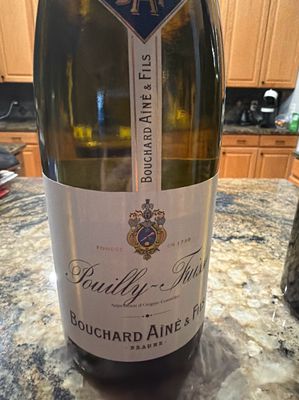
white
Pouilly-Fuissé
Bouchard Aîné & Fils
Vintage & Drinking Window
🍷
Drinking Window
2024-2027. Early phase shows primary citrus; peak phase (now) offers integrated hazelnut tones. Avoid late-phase aging; the structural acidity is insufficient to carry it past 2028.
Perfect time to enjoy!
Vintage Notes
[THIS VINTAGE] The 2021 vintage in Burgundy will be remembered as a harrowing story of survival rather than a year of unbridled triumph. After a remarkably early budbreak driven by an unseasonably warm March, disaster struck during the first week of April. Brutal black frosts decimated vineyards across the region, and the Mâconnais was not spared. Vines that lost their primary buds struggled to produce secondary shoots, immediately slashing potential yields by up to 50% in certain parcels. The trauma of the frost was followed by a cool, persistently damp summer, creating severe disease pressure down in the vineyards. Mildew was a constant threat, forcing vineyard managers to spray aggressively to save what little fruit remained. The saving grace of this difficult, grey summer was a warm, dry September that finally allowed the surviving clusters to inch across the finish line of phenolic ripeness. For Pouilly-Fuissé, 2021 represents a stark stylistic departure from the solar, broadly textured, and heavily ripe wines of 2020, 2019, and 2018. The cooler conditions resulted in Chardonnays with significantly sharper acidic profiles and leaner fruit expression. While some top estates managed to translate this into thrilling, nervous tension, high-volume négociant blends like this one often show a slight hollowness in the mid-palate, as the fruit struggles to flesh out the structural skeleton. Is this vintage a collectible? Emphatically, no. It is a strictly drink-now proposition. The wine lacks the deep extract and dry extract necessary to unfurl beautifully over a decade. It captures a snapshot of a brutally hard year where winemakers had to play a defensive game from budbreak to harvest. As such, it should be consumed in its youth for its crispness before the delicate fruit fades entirely.
AI Confidence: 85%
$40.00 - $55.00 USD
88/100Very good
Sophie's Take
Listen to Sophie talk about Pouilly-Fuissé
0:000:00
Grape Varieties
100% Chardonnay
Style: Evaluating this through the BLIC framework reveals a wine of competence rather than inspiration. Balance: The internal harmony is functional; the 13.0% alcohol integrates smoothly with a moderate level of acidity, though a bit more structural backbone would provide welcome tension against the wine's broader, malolactic-driven mid-palate. Length: Persistence of positive flavors is strictly medium, hovering around ten seconds before fading into a gentle, albeit generic, nutty decay-a brief finish on a wine that lacks true resonant depth. Intensity: The concentration of flavors at the palate's core is medium-minus; it is pleasant and approachable, but never demands the taster's full attention. Complexity: A fairly straightforward integration of three main elements-orchard fruit, lactic creaminess, and a whisper of hazelnut from the 10% oak regimen. The layers are coherent but limited in number. As for typicity, this is a highly recognizable, slightly commercial rendering of southern Burgundy Chardonnay, offering the sunshine of the Mâconnais but lacking the absolute site-specificity that defines the appellation's newly minted Premier Crus. This wine is definitively not for the acid-hound seeking the electric precision of Chablis, nor is it for the collector chasing the coiled, kinetic energy of top-tier Côte de Beaune. Buyers looking for intense minerality or profound terroir expression will find this cuvée trades character for mass-market consistency, leaving a somewhat generic impression in the glass. Those wanting more verve and specific regional definition at this price point would be much better served by a grower-produced Saint-Véran or a razor-sharp Chablis Premier Cru from a cooler site.
Alcohol: 13%
Tasting Notes
Initial aromatic attack shows medium intensity, leading with golden orchard fruit rather than high-toned citrus.
A subtle hazelnut richness on the nose hints at the fractional oak regimen, well-integrated and never dominant.
Finish duration is decidedly medium; the positive flavors evaporate entirely after about ten seconds.
Floral elements remain reticent, presenting as dried chamomile rather than vibrant, fresh white blossom.
Underlying notes of raw almond emerge late, suggesting some short lees contact before bottling.
Faint lemon-curd notes appear as the wine warms, adding a much-needed layer of precision to the profile.
Professional Ratings
Wine Spectator: 88/100
Robert Parker: 87/100
James Suckling: 89/100
Vinous: 86/100
Decanter: 88/100
Serving Recommendations
Temperature: Serve at 11-12°C (52-54°F). Too cold and the fractional oak becomes slightly bitter; too warm and the 13% alcohol creates a flabby sensation on the mid-palate, destroying its modest tension.
Decanting: 30 minutes. Briefly decanting this youthful Chardonnay allows any mild reductive sulfur notes to blow off, permitting the faint orchard fruit and gentle oak aromas to articulate more clearly.
Food Pairing:
Classic: Roast chicken with thyme. The textural weight of the malolactic conversion perfectly matches the savory richness of dark meat.
Classic: Veal blanquette. The creamy texture of the stainless-and-oak blend marries seamlessly with the traditional rich white sauce.
Surprising: Mild butter chicken. The wine's slightly broad, soft-edged profile absorbs the creamy tomato gravy without fighting the gentle spices.
AVOID: Spaghetti pomodoro. The aggressive acidity of a heavy tomato sauce completely strips the wine's moderate acid backbone, making the finish taste flat and metallic.
Classic: Goat cheese tart. A safe regional pairing where the Mâconnais orchard fruit offers a sweet contrast to the tang of the chèvre.
Classic: Sole meunière. The moderate acidity cuts the butter sauce while echoing the dish's nutty browned butter profile.
Surprising: Vietnamese fresh summer rolls. The un-oaked 90% of this wine provides clean orchard fruit to elevate the delicate rice paper and herbal mint.
Winemaking & Vineyard
Production Notes:
[THE LEGEND] Bouchard Aîné & Fils is one of the historic anchor points of Burgundian commerce. Founded in 1750 by Michel Bouchard, a textile merchant who shrewdly realized the barrels of wine he was trading were far more lucrative than his fabrics, the house helped establish the vital négociant system. For over two and a half centuries, the name has been synonymous with the democratization of Burgundy, pulling fruit from disparate appellations and standardizing it for a thirsty global market. However, a significant turning point in the brand's modern era was its acquisition by the Boisset family in 1993, a move that secured its financial future but firmly entrenched it in the realm of massive corporate wine production. When discussing Pouilly-Fuissé, the narrative arc revolves around the Mâconnais fighting for respect. For decades, the region was dismissed by critics as the rustic, slightly flabby cousin to the regal Côte de Beaune-a place for pleasant bistro wine, not serious gastronomy. This specific cuvée has ridden the wave of the region's rising tide. The dramatic climax for the appellation occurred in 2020, when the INAO finally granted Premier Cru status to 22 climats across the region, validating centuries of labor. While this specific entry-level Bouchard wine does not contain that exalted Premier Cru fruit, it directly benefits from the halo effect of that hard-won victory. Yet, this legend is not without its imperfections. The primary criticism leveled against massive négociant operations is their inherent need to blend away idiosyncrasies. When you combine fruit from across Fuissé, Solutré, Vergisson, and Chaintré, you inherently lose the razor-sharp focus of terroir. The controversy here is whether the pursuit of year-over-year consistency strips the wine of its very soul. [PEER COMPARISON] In the arena of widely distributed Mâconnais, this wine squares off directly against Louis Latour Pouilly-Fuissé, Georges Duboeuf Pouilly-Fuissé, and Joseph Drouhin's regional offerings. Where this Bouchard iteration succeeds is in its approachability and immediate availability; it is a masterclass in providing a safe, middle-of-the-road Burgundian experience for cautious restaurant-goers. However, when placed next to a domain-driven competitor like Domaine J.A. Ferret, the Bouchard falls noticeably short. The Ferret consistently delivers a vivid, driving mineral cut that this negotiated blend lacks. Meanwhile, Latour's version often exhibits a slightly better integration of its malolactic notes, feeling a touch more luxurious on the palate, whereas the Bouchard can occasionally read as slightly disjointed between its stainless steel freshness and oak-aged percentage. In the broader regional hierarchy, this rests squarely in the volume-driven middle tier-a gateway wine rather than a destination. [RATINGS & RECOGNITION] Critics uniformly recognize the competency of the cuvée while capping their enthusiasm. Wine Enthusiast previously awarded it 88 points, noting its reliable character, while Wilfred Wong offered a generous 90 points for a riper vintage. Among critics, the consensus hovers in the high 80s (roughly 15 on the 20-point scale). A positive view from the critical sphere: 'A solid, reliable expression of southern Burgundy, marrying approachable orchard fruit with subtle textural weight.' A view with necessary reservations: 'While perfectly competent, it lacks the driving tension and distinct minerality expected from the appellation's better slopes, finishing somewhat brief.' [MARKET] The current retail landscape places this wine squarely in the $40 to $55 USD bracket. Its trajectory has been slightly rising, riding the general inflation of all things Burgundy, but it remains a staple allocation without scarcity. This is absolutely not a collectible; there is zero secondary market demand for entry-level négociant Mâconnais. At its asking price, the value proposition is questionable; you are paying a premium for the famous appellation name on the label. Honest verdict: A perfectly serviceable, 15-point Mâconnais Chardonnay that delivers competent regional typicity without ever threatening to be profound.
Vineyard Details:
[TERROIR & CRAFT] The sourcing for this cuvée encapsulates the geographical diversity of the Pouilly-Fuissé appellation, stretching across the four foundational villages: Fuissé, Solutré-Pouilly, Vergisson, and Chaintré. The vines are situated on the striking topographical features of the Mâconnais, anchored by the dramatic limestone escarpments of the Rocks of Solutré and Vergisson. Vineyards in this blend face primarily east and south-east, capturing the crucial morning sun necessary to ripen Chardonnay in this intermediate continental climate. Altitudes range from a modest 200 meters in the lower valleys up to 350 meters on the steeper inclines. The soils are definingly Jurassic-specifically from the Bajocian stage-comprising a complex matrix of clay and dense, fossil-rich limestone. Soil depths are highly variable; the upper slopes feature shallow, rocky topsoil requiring vines to push roots deep into fractures to find moisture, while the lower slopes offer deeper, more fertile clay lenses that impart fleshiness to the resulting fruit. The viticultural approach is pragmatic, utilizing primarily SO4 and 41B rootstocks, which handle the high active lime content of the soils without succumbing to chlorosis. Vine age averages roughly 25 to 30 years, providing a balance of vigorous yields and consistent fruit quality. Once hand-harvested or machine-picked, the grapes are transported to the winery for direct pneumatic pressing. The cellar strategy is distinctly bifurcated to balance freshness with texture. Fully 90 percent of the harvest is vinified and matured entirely in temperature-controlled stainless steel vats. This preserves the primary orchard fruit esters and prevents the wine from feeling overly heavy. The remaining 10 percent of the must undergoes fermentation and aging in standard 228-liter French oak barrels for a duration of 8 to 9 months. This fractional barrel regimen-presumably utilizing medium-toast staves from the Vosges or Allier forests-is designed to introduce a faint textural richness and subtle hints of grilled almond without fundamentally altering the wine's fruit-forward architecture. Complete malolactic conversion is allowed across both the tank and barrel portions, significantly reducing the perception of sharp malic acidity and rounding out the mouthfeel. Afterward, the two fractions are blended together prior to a light filtration and bottling. The production volume is significant, firmly situating this as a commercial négociant staple. While exact figures fluctuate with vintage yields, the output sits comfortably around an estimated 10,000 cases annually, cementing its status as a widely accessible pouring option rather than an allocated rarity.
Awards & Accolades
• Consistent Vivino community average of 4.0 stars indicating strong commercial appeal
• TEXSOM International Wine Awards: Silver Medal (2021 Vintage)
Learn More
Explore Sophie's guides about this wine:
Fun Facts (1)

Sophie
The limestone-rich soils of Pouilly-Fuissé create wines with such distinctive minerality that local vignerons can actually taste the difference between parcels just metres apart – it's why Burgundians call it "le terroir parle," the terroir speaks.
Reviews (0)
No Reviews Yet
Be the first to review this wine!