Sophie, The Wine Insider
Oenologist, troublemaker, your new favourite drinking buddy
Seared Tuna: White Wine Wisdom
How crispy sashimi-grade tuna meets three versatile whites
Written by
Sophie, The Wine Insider
15 min read
2,882 words
Seared Tuna: White Wine Wisdom
The Audio Edition
Listen to Sophie & Chad talk about Seared Tuna: White Wine Wisdom
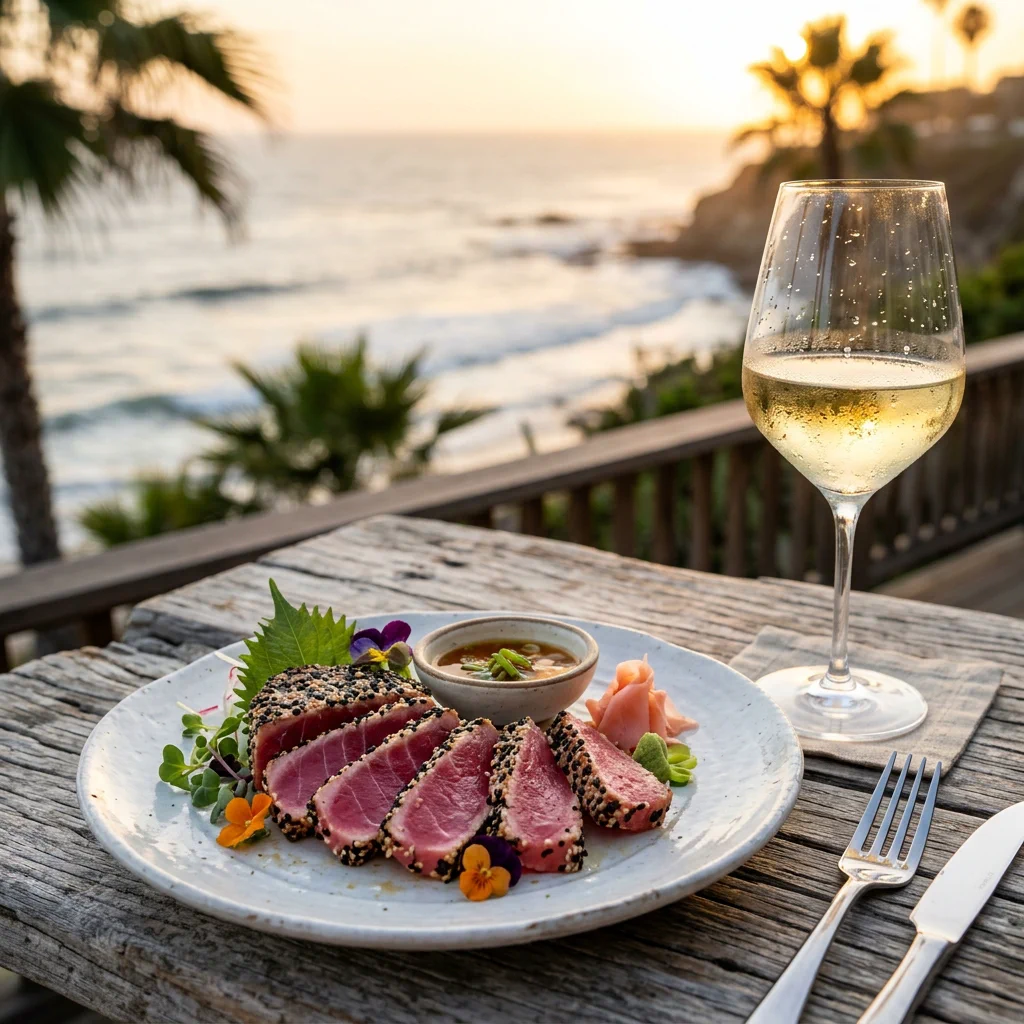
Seared ahi tuna occupies a strange and wonderful category of cuisine: a dish that looks like steak, eats like steak, and wants the wine pairing of a delicate fish. This is the paradox that sends otherwise sensible home cooks reaching for a Pinot Noir or—brace yourself, darling—a rosé of indeterminate colour, when what the dish actually wants is a crisp, mineral-driven white wine. Yes, I'm serious. No, this isn't me being contrarian. The seared exterior of a good tuna steak is pleasingly caramelised, but the interior is essentially ruby-coloured sashimi—cool, silky, oceanic, and far more subtle than any seared-crust illusion suggests.
A serious red wine with seared tuna is a rookie error I watched a friend make at a restaurant once: he ordered a Pinot Noir, took one bite of the tuna, took one sip of the wine, and made the face of a man who had just licked a penny. The iron and tannins fought the delicate fish and the whole plate went sideways. Meanwhile, the woman across the table had ordered a Sancerre, and she was simply having the best meal of her life. Tonight I'm breaking down three whites that understand the assignment: a critically acclaimed Chenin Blanc-Viognier blend from Napa, a bright Sancerre from the Loire, and a surprising white Côtes du Rhône that proves southern France wasn't done making lovely wines once the red grapes had their say.
Why White, Why Now, Why Not Tempranillo
Seared tuna is the textbook example of a food that looks tannin-friendly and isn't. The fish itself is oil-rich (bluefin and yellowfin both contain high levels of omega-3 fatty acids and polyunsaturated fats), and those oils interact catastrophically with the tannins in red wine. Take a sip of Cab after a bite of raw or seared tuna and you get an unpleasant metallic flavour—what wine chemists politely call 'iron/tannin clash.' What you actually want is a wine with bright acidity to cut through the oil, clean minerality to echo the oceanic quality of the fish, and a structured body—not a flabby, fruit-bomb white that gets drowned by the meal.
This is why classical French fish pairings always point toward cool-climate, high-acid, mineral-driven whites: Sancerre, Muscadet, Chablis, Pouilly-Fumé, Vouvray. It's also why Sauvignon Blanc from the Loire is arguably the single best white-wine style in the world for delicate, oily-textured fish—it's the wine-world equivalent of squeezing a lemon wedge over the plate, except with more personality. That said, we're not limiting ourselves tonight. I've got a California blend and a Rhône white alongside the Sancerre, and each brings something interesting to the party.
The Iron-Tannin Problem, Briefly
Fish oils contain trace iron that, when combined with red-wine tannins, produces a metallic, fishy aftertaste in the mouth. This effect was formally documented in a 2009 Japanese study that traced the reaction to the interaction between iron(II) and wine-derived polyphenols. The researchers tested dozens of wines against sushi and found that reds with higher iron content and more tannins produced the most off-flavours. Fun corollary: white wines with lower iron content (cool-climate whites in particular) avoid the problem entirely. Science backing up what every Parisian waiter has told you for decades.
The Three Whites, From California to the Loire
These three bottles live at very different price points and represent three different approaches to the tuna pairing. The Pine Ridge is the value-obsessed Californian workhorse. The Sancerre is the textbook classical pairing. And the Côtes du Rhône Blanc is my wildcard—the bottle nobody pours with fish, and everyone should.
1. Pine Ridge Chenin Blanc + Viognier 2024 — The California Underdog
This is one of the most absurdly-priced wines on any shelf in America. Pine Ridge Vineyards is a respected Napa producer (founded in 1978, known for their Stags Leap District Cabernets), and this white blend—roughly 80% Chenin Blanc, 20% Viognier—is their entry-level bottling. Retail is a bewildering $11–17, and at that price it's earning serious critic love: James Suckling 91 and Wine Spectator 90. For a sub-$20 white to score 90+ points from two major scoring houses is borderline statistical anomaly. Someone in the Pine Ridge cellar is quietly outperforming their pay grade.
The Chenin Blanc does the structural work—bright acidity, crisp green-apple backbone—while the Viognier brings aromatic intrigue in the form of white peach, honeysuckle, and a softening floral lift. Together they make a white that's lively but never angular, fruit-forward but never flabby. It's the sort of wine you could open on a Tuesday because it's Tuesday, and no one would raise an eyebrow.
Tasting Profile
The nose opens with stone fruits—peach, nectarine—citrus zest, and subtle honeysuckle florals. The palate is crisp and refreshing with flavours of white peach, pear, green apple, and a whisper of tropical fruit on the mid-palate. Pale golden yellow in the glass with bright clarity. The finish is clean and dry with pleasant acidity and a lingering fruity aftertaste. It's friendly, approachable, and absolutely well-made. The kind of wine that goes down too easily.
Why It Works with Seared Tuna
The bright acidity carves through the natural oils in tuna without overpowering the delicate flesh. The stone-fruit and honeysuckle aromatics amplify the savoury-sweet character of a good ponzu or teriyaki glaze, and the Chenin Blanc backbone keeps the wine structured enough to handle any sesame-crust situation without collapsing. For a weeknight tuna dinner that doesn't require you to take out a wine mortgage, this is the bottle.
“For a sub-$20 white blend to land 91 from James Suckling and 90 from Wine Spectator in the same vintage is the kind of statistical outlier that makes you re-read the tasting notes to make sure you got the price right. Pine Ridge is quietly doing something interesting with their entry-level white, and critics have noticed.”
Sophie, on why Pine Ridge overachieves
Price-to-Plate
At $11–17, this wine costs less than half the seared tuna fillet you're about to cook. That's a bit bonkers, frankly. For a dinner-party pairing where you're serving 4–6 people, buy two or three bottles of this and still spend less than you would on one bottle of many 'proper' fish wines. The value math is ridiculous in your favour.
2. Château de Sancerre 2022 — The Textbook Pairing
If you've ever eaten seafood in France, you've almost certainly been offered a Sancerre. It's the default, the safe choice, the wine every French waiter reaches for when a customer orders fish and asks for 'whatever's good.' The reason: the Loire Valley village of Sancerre, on the upper reaches of the river, produces what is arguably the single greatest expression of Sauvignon Blanc in the world. Cool climate, flinty limestone soils called silex, and centuries of accumulated winemaking knowledge combine to produce wines of ethereal minerality and razor-sharp acidity.
Château de Sancerre 2022 scored James Suckling 92—right in the sweet spot for a classical Sancerre. Price: $18–28. The 2022 vintage in the Loire was warm but balanced, producing wines with enough ripeness to avoid the green, herbaceous-grass notes that some people don't love in Sauvignon Blanc, while preserving the bracing mineral backbone that makes Sancerre so magical with seafood.
Tasting Profile
The nose opens with grapefruit, passionfruit, white flowers, and subtle flinty notes—that classic Sancerre smoke-and-stone character that cool-climate Sauvignon Blanc does better than any other wine on earth. The palate is crisp and clean with citrus and wet-stone flavours. A long, mineral, persistent finish. Pale golden yellow with bright clarity. This is a wine where you can almost taste the limestone soil.
Why It Works with Seared Tuna
Sancerre with seared tuna is one of those pairings that feels like it was engineered by the same team. The flinty mineral backbone echoes the oceanic quality of the fish. The bracing grapefruit-and-citrus acidity cuts through the natural tuna oils with surgical precision. And the subtle white-flower aromatics lift the whole experience without ever competing with the delicate fish flesh. It's the pairing every French bistro quietly perfected decades ago. You're simply benefiting from their homework.
“James Suckling scored this Château de Sancerre at 92, which places it comfortably above the critical median for the appellation. Sancerre is the classical white-wine pairing for any oil-rich fish, and this bottling is a benchmark version of the style—textbook in all the right ways.”
Sophie, on the Sancerre benchmark
Price-to-Plate
$18–28 for a 92-point Sancerre is entirely reasonable, and this is the bottle I'd bring to a dinner party where someone's cooking fish and you have no idea what they're pouring. It's so unambiguously the right answer that you'll look like a wine savant without having to explain yourself. Pair with the faint smile of someone who knows they've done the correct thing.
3. Côtes du Rhône Blanc — The Wildcard That Won Me Over
Now for the wildcard. Southern Rhône is a region everyone associates with big, herbal, sun-baked red wines—Châteauneuf-du-Pape, Gigondas, Vacqueyras, the whole GSM lineup. What almost nobody talks about is that the Rhône Valley also produces remarkable white wines from grapes that sound like characters in a French fantasy novel: Marsanne, Roussanne, Grenache Blanc, Viognier, Clairette. These whites are underrated, underpriced, and astonishingly food-friendly. This particular Côtes du Rhône Blanc has scored Decanter 90, James Suckling 90, Robert Parker 90, Vinous 89, and Wine Spectator 89—five major critics, five consistent 89–90 scores. That's consensus, not a lucky review.
Price: $17–25. What this wine brings to seared tuna that the Sancerre and Pine Ridge don't is a slightly richer, fuller-bodied texture—the Marsanne and Roussanne grapes provide a honeyed, almost viscous mid-palate weight that coats the tongue beautifully alongside a fatty tuna fillet. It's the move when you're doing a richer preparation: sesame crust, miso glaze, or anything with a buttery sauce.
Tasting Profile
Aromatic nose of white peach, apricot, and floral notes with hints of honeysuckle and light spice. After five minutes in the glass the nose deepens dramatically, unfurling fleshy white peach, ripe apricot, honeycomb, and wet river stone. Pale gold with light green reflections. The palate has a satisfying richness—that Marsanne-Roussanne viscosity—balanced by bright acidity that keeps everything aloft. Long, refreshing finish with lingering stone fruit.
Why It Works with Seared Tuna
The honeyed richness of the Marsanne-Roussanne blend locks beautifully into miso-glazed or teriyaki-marinated tuna preparations—the wine has enough body to match a fattier preparation without being flabby. The wet-stone minerality picks up the oceanic quality of the fish, and the vibrant 2022 acidity (for the current vintage) handles the oils cleanly. This is the bottle when your tuna is dressed up with sauces or crusts. The Sancerre wants plainer preparations; this wine wants the full treatment.
“When five major critics line up with scores of 89–90 on a sub-$25 white blend, that's not a fluke. That's a wine doing the same thing well, year after year, in a region most American drinkers haven't even looked at for whites. Côtes du Rhône Blanc is the best-kept secret in French value whites.”
Sophie, on consistent critical consensus
Price-to-Plate
$17–25 for a white with five 89–90 critic scores is absurd value. You're paying less than a decent Sancerre and getting a more interesting, fuller-textured wine with a more distinctive aromatic profile. If you want to look like you've been to the south of France recently, pour this. If you want to pair it with a slightly fancier fish preparation, even better.
Sophie's Pick
The Verdict
Three brilliant whites, three different best-for scenarios, and—for once—no single dominant winner. If you're doing a classic seared tuna with light dressings, a lemon-ponzu drizzle, or a simple arugula salad, go with the Château de Sancerre 2022. It's the textbook pairing and it will never let you down. If you're doing something richer—a sesame crust, a miso glaze, a buttery beurre blanc—reach for the Côtes du Rhône Blanc. The Marsanne-Roussanne richness handles fuller preparations beautifully. And if you're cooking on a Tuesday and just want a genuinely good white for roughly the price of a sandwich, grab the Pine Ridge. All three wines are right answers to slightly different questions.
If forced to pick a single hero for a dinner party where the theme is 'seared tuna done right,' I'd go Sancerre. It's the wine I trust in every scenario, the wine that works whether the tuna is sauced or plain, seared hard or left nearly raw. It's the safe brilliant answer. The other two bottles are contextually better in their specific scenarios. But the Sancerre is the bottle I'd hand to someone hosting dinner and say, 'This. Trust me.' And it would work.
Searing the Tuna (Because This Matters Too)
Sophie's Tuna Method
Start with the best tuna you can source—sashimi-grade yellowfin or bluefin, ideally. Pat completely dry with paper towels; moisture is the enemy of a proper sear. Season aggressively with flaky sea salt and freshly cracked black pepper. Heat a cast-iron skillet or carbon-steel pan to screaming-hot (smoke-point hot, not 'medium-high'). Add a neutral high-smoke-point oil—grapeseed or avocado, never olive. Sear the tuna 60–90 seconds per side, no more. The centre should be cool and ruby-red; the crust should be deeply browned and fragrant. Rest for 2 minutes, then slice against the grain in 1/4-inch pieces. Serve immediately.
- Buy sashimi-grade tuna from a trusted fishmonger—no exceptions, no substitutes.
- Pat completely dry with paper towels before seasoning.
- Season with flaky sea salt + freshly cracked black pepper (or a sesame crust).
- Heat the pan until it's genuinely smoking—don't compromise here.
- Use a neutral high-smoke-point oil (grapeseed or avocado).
- Sear 60–90 seconds per side. Resist the urge to cook longer.
- Rest 2 minutes, slice against the grain, serve immediately with wine.
Pouring the Wine (The Service Details)
Sophie's Service Notes
Whites are forgiving, but they have their own temperature sins. Too cold (straight from the fridge) and you mute the aromatics. Too warm and the wine loses its cleansing acidity. The sweet spot is 48–52°F—cold enough to feel bracing against the fish, warm enough to let the fruit and minerality come through. Pull the bottles from the fridge 10 minutes before you plan to pour. Use proper white-wine glasses (tulip-shaped, narrower than red bowls) to concentrate the aromatics. And pour small first pours—these wines will warm in the glass as you drink, and that evolution is part of the pleasure.
- Serving temperature: 48–52°F (10 minutes out of the fridge before service).
- Use tulip-shaped white-wine glasses, not the fat all-purpose ones.
- No decanting necessary for any of these bottles—whites don't need it.
- Pour small first pours (3–4 oz). You'll refill as the wine evolves in the glass.
- These wines are young and fresh—drink the bottle the night you open it.
Building the Full Tuna Plate
Seared tuna is clean, elegant food. The rest of the plate should respect that. Skip heavy sauces, skip rich starches, skip anything that wants to compete for the spotlight. What you want is acidity, crunch, and subtle oceanic echoes—things that amplify the tuna without stealing its thunder.
Sides That Actually Work
- Cucumber salad with rice vinegar, sesame oil, and toasted sesame seeds
- Steamed edamame with flaky sea salt
- A small portion of sushi rice or jasmine rice with a scatter of furikake
- Avocado slices with lime, flaky salt, and a drizzle of good olive oil
- Pickled ginger on the side for palate cleansing between bites
- Ponzu or tamari in a small dish for dipping — not drowning — the tuna
The whole plate should feel Japanese-minimalist in its restraint, even if the cooking technique is fundamentally European. The wine plays its part by providing bright, clean acidity to reset the palate. The tuna provides the oceanic main character. Everything else is supporting cast: essential, quiet, and gracefully on its mark.
The Chemistry (One More Time)
The hidden elegance of pairing white wine with oily fish is that it's a chemistry story as much as a flavour one. The iron content in fish interacts with the tannin levels in red wine, creating off-flavours. Cool-climate whites—Sancerre, Chablis, German Riesling, good Loire Sauvignon Blanc—have virtually no tannin and low iron content, which means they sidestep the problem entirely. Their high titratable acidity (often 6–8 g/L, much higher than most reds) provides the cleansing 'lift' that oil-rich fish desperately needs between bites. And their mineral backbone—the 'wet stone' or 'flinty' notes—actually contains trace minerals that echo the natural salinity of seafood, creating a genuine aromatic conversation between the plate and the glass. That's not wine-writer flourish. That's lab-verified flavour chemistry, and it's the whole reason French seafood culture has been pouring Sancerre and Muscadet with fish for centuries.
Silex — The Stone That Makes Sancerre
The famous 'flinty' character in Sancerre comes from the region's three main soil types: caillottes (limestone pebbles), terres blanches (chalky marl), and silex (flint). The silex soils in particular imprint wines with that unmistakable gunpowder-and-stone aromatic character. Vineyards planted on silex produce the most expressive, mineral-driven Sancerres—wines where the rocks in the ground become, almost literally, the flavour in the glass. That's terroir at its most dramatic and most honest. Drink a silex-grown Sancerre alongside seared tuna and you'll understand why the French invented the word.