Chad, The Wine Convert
Tech founder, Napa regular, surprisingly good taste
Wild Mushroom Risotto: Premium Red Wine Territory
Why risotto demands serious Cabernet and Pinot when done right
Written by
Chad, The Wine Convert
15 min read
2,995 words
Wild Mushroom Risotto: Premium Red Wine Territory
The Audio Edition
Listen to Sophie & Chad talk about Wild Mushroom Risotto: Premium Red Wine Territory
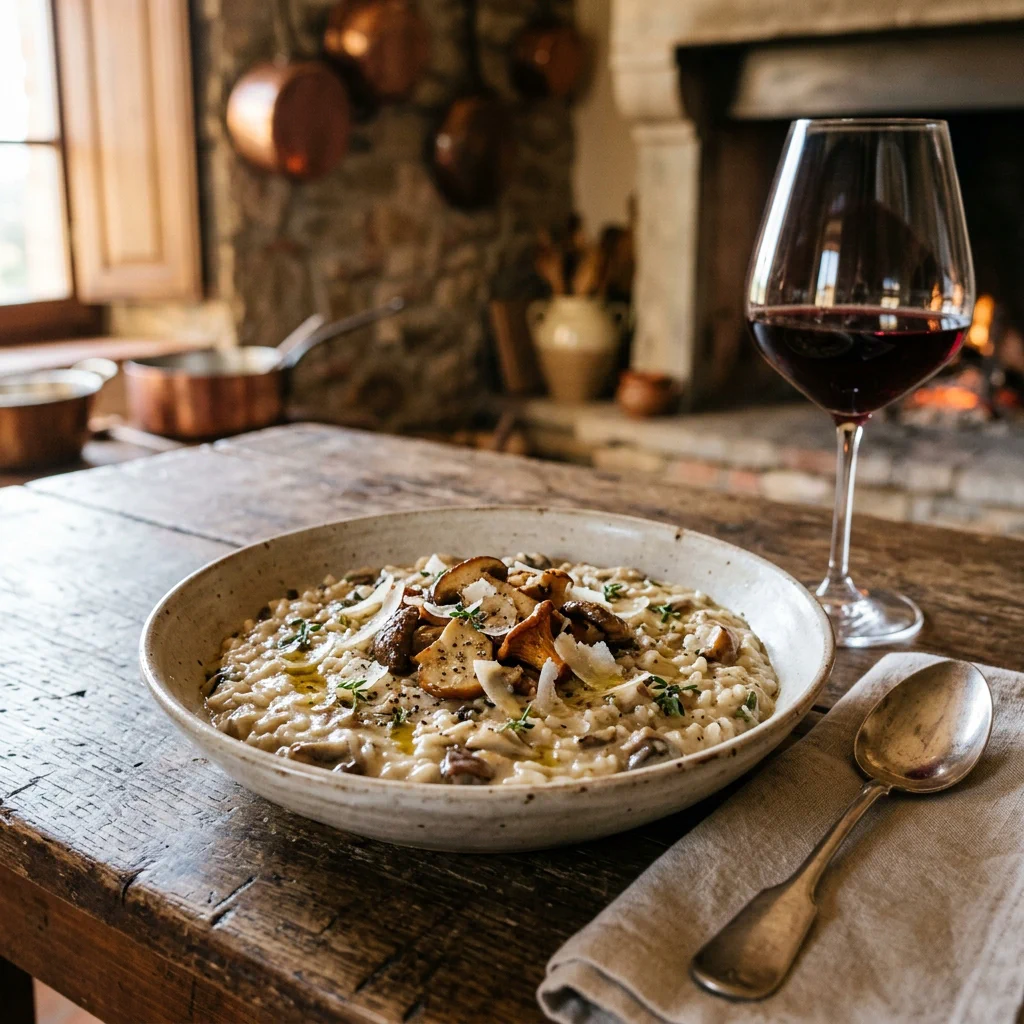
Here's a confession: for years I treated risotto as a 'white wine dish.' I'd make it with a decent Chardonnay, pour a glass of the same wine at the table, and call it a night. That was fine. Unremarkable, but fine. Then one night I ran out of Chardonnay while making a wild mushroom risotto—porcini, cremini, shiitake, a handful of dried morels I'd been saving—and I opened a bottle of Napa Cab instead because it was the only red I had cold enough to drink. It was, straight up, the best risotto pairing of my life. I've never gone back.
Wild mushroom risotto is not your standard risotto. Once you're cooking with actual forest mushrooms—not just the supermarket button mushrooms, but porcini, chanterelles, morels, shiitake—the dish shifts from a gentle carb-and-cream affair into something deeply savoury, umami-loaded, almost beefy in its flavour profile. The rice is the delivery mechanism, but the mushrooms are running the show. And mushrooms, it turns out, have an absurd natural affinity for red wines that pick up on the forest-floor and earthy notes they bring. Tonight I'm pouring three bottles from opposite ends of the spectrum: a full-bodied Napa Cab, a graceful old-world Burgundy, and a polished California Pinot that sits right in between. All three earned their spot. All three would be my pick for the right version of the dish.
The Umami Bridge Between Wine and Mushrooms
There's a real chemistry story here, and it's worth understanding because it changes how you shop for wine once you get it. Mushrooms are one of the most umami-rich foods on the planet—they contain high levels of glutamate, guanosine monophosphate, and inosinate, three compounds that activate the fifth taste receptor (the one we call 'savoury'). When you cook mushrooms slowly—especially dried mushrooms reconstituted in warm broth—you amplify those compounds dramatically. Dried porcini has roughly ten times the glutamate of fresh porcini. So a wild mushroom risotto made with a generous handful of dried porcini is, from a flavour-chemistry perspective, the umami equivalent of dry-aged beef.
Aged red wines—especially those with some bottle age, forest-floor undertones, or tertiary development—contain their own umami compounds. When you put the two together, they don't just coexist. They actively amplify each other. This is why aged Burgundy with mushroom risotto is a classical pairing in every French cookbook for the past century, and why my accidental Napa Cab discovery was actually not an accident at all. Both wines were carrying umami compounds that locked into the mushrooms. It's flavour chemistry doing its quiet work.
Why Dried Mushrooms Hit Harder
Drying mushrooms concentrates their glutamate content roughly 10x, turning a mild fresh mushroom into a flavour bomb. That's why every serious mushroom risotto recipe insists on at least some dried porcini, even if you've got a kilogram of beautiful fresh ones—the dried ones bring the savoury intensity that fresh can't match. Save the soaking liquid too. That's liquid umami.
The Three Bottles I'd Pull for This Dish
Each of these wines approaches the risotto from a different angle. The Duckhorn brings raw power and tannic structure. The Santenay brings old-world finesse and that unmistakable Burgundian forest-floor note. The Twomey Pinot brings bright fruit and a silky texture that complements the creamy rice. Three different philosophies. All three valid. I'll tell you which one I'd pour for which version of the dish.
1. Duckhorn Three Palms Vineyard Cabernet Sauvignon 2011 — The Heavyweight
This is the same wine I recommend for grilled ribeye, and there's a reason: it's one of the most serious Napa Cabs you can buy at a non-cult-wine price. Three Palms Vineyard is a legitimately historic single-vineyard site in the northern part of Napa Valley, named for three palm trees standing at the top of a rocky alluvial fan. Duckhorn has been making wine from it for decades. The 2014 vintage famously won Wine Spectator's 'Wine of the Year' in 2017. The 2011 I'm drinking tonight isn't that trophy vintage, but it's 14 years old, sitting at absolute peak right now, and the producer's own drinking window says it'll hold through 2035. Price: $80–145.
Why a big Napa Cab with risotto? Because when wild mushroom risotto goes serious—truffle oil, aged Parmesan by the handful, dried porcini in the stock, maybe a spoonful of foie gras stirred in at the end for the once-a-year move—it takes on a weight and depth that calls for a wine with genuine structure. The Duckhorn is that wine. This is not a Tuesday risotto pairing. This is a 'I'm making this for someone I love and I'm pulling out the stops' pairing.
What It Tastes Like
Cranberry and cassis on entry with surprising acidity for a 14-year-old Napa Cab (cool 2011 vintage). Mid-palate broadens into fleshy blue fruit, huckleberry, lavender, cinnamon, clove, and cedar. The finish is long, tobacco-forward, and complex. Tannins are softened by bottle age but still firm enough to frame the wine. This is what aged Napa Cab is supposed to taste like—and a lot of them don't deliver. This one does.
Why It Works with Mushroom Risotto
The umami-bridge story I told you earlier? This wine is an umami bomb in its own right. Duckhorn's own food pairing notes explicitly call out 'roasted mushrooms and truffle dishes' as a hero pairing—not an accident, not marketing copy. The cedar and tobacco notes pick up beautifully on the earthy mushroom flavours, and the soft tannins have just enough grip to cut the creamy Parmesan richness. If you're using truffle oil, this is the bottle. Full stop.
“Duckhorn's winemaking team specifically calls out roasted mushrooms, truffle dishes, and braised short ribs as the heroes for this wine—that's not generic pairing copy, that's a winemaker telling you 'we tasted this alongside mushrooms and the wine got better.' When the producer themselves points at mushrooms as a pairing, believe them.”
Chad, on the Duckhorn pairing notes
The Value Math
$80–145 is splurge territory, I know. But think about the math differently: a serious wild-mushroom-and-truffle risotto at a white-tablecloth restaurant runs $40–55 per plate, and the wine pairing they pour is a $25 glass that retails for $60. Two people, one plate each, one wine: you're at $170 for the experience. This Duckhorn at home covers two diners, three courses, and you still eat for less. I don't make the rules—I just do the math.
2. Santenay-Maladière Premier Cru 2022 — The Old-World Classic
Now let me talk you into a Burgundy. Specifically, let me talk you into a Santenay Premier Cru, which is one of the great secret-handshake bottles in the wine world. Santenay sits at the southern end of the Côte de Beaune, and because it doesn't have the name recognition of Pommard or Volnay, the prices stay reasonable while the quality stays very much not-reasonable. This Santenay-Maladière Premier Cru 2022 is $45–65 and earned a staggering Decanter 97, James Suckling 93, Robert Parker 90, Vinous 91, and Wine Spectator 90.
I realise 'pour a Burgundy with risotto' sounds French-cookbook-textbook, and it is—because it works. Burgundian Pinot Noir has forest-floor, mushroom, and truffle undertones built right into the varietal character. It doesn't just pair with mushroom risotto. It speaks the same language. If you're not ready to spend $100+ on Napa Cab for a mushroom risotto night, this is the bottle. It delivers the classical pairing at a price that feels almost dishonest.
What It Tastes Like
The nose is vivid wild strawberry, bing cherry, and a flicker of cranberry. Medium-bodied with silky tannins and a telltale Burgundian forest-floor undertone that shows up immediately. Mid-palate brings mushroom, minerality, and a graphite spine. The finish is a sensational blood-orange acidity with a saline snap that holds for 45 seconds. It's the sort of wine where you take a sip and stop talking mid-sentence because you're listening to what it's doing.
Why It Works with Mushroom Risotto
The forest-floor and mushroom notes in the wine literally echo what's happening in the dish—it's like the wine was grown to be drunk alongside this food. Burgundian Pinot has been paired with mushroom-based French classics for centuries because the flavour vectors align perfectly. The blood-orange acidity cuts the creamy Parmesan richness, the red fruit lifts the umami weight, and the mineral graphite picks up on the roasted mushroom edges. This is the classical pairing, and for a reason.
“When Decanter gives a sub-$70 Premier Cru a 97 and four other major scoring houses line up in the 90–93 range, you're not looking at a vintage fluke. You're looking at a producer who has been quietly outperforming their appellation for years—and at a price point where a California equivalent would cost two to three times as much.”
Chad, on why critics keep rewarding Santenay
The Value Math
$45–65 for a critically acclaimed Premier Cru Burgundy is frankly absurd. This is the price of a mid-tier California Pinot, and you're getting a legitimately serious old-world wine with a 97-point Decanter score. If you've been intimidated by Burgundy because of the price tags on Volnay, Gevrey, and Vosne-Romanée, Santenay is your entry point. And mushroom risotto is the dish that will make you understand why the French have been doing this for centuries.
3. Twomey Pinot Noir Russian River Valley 2021 — The Modern Middle Ground
Twomey is Silver Oak's Pinot-and-Merlot-focused sister winery, founded in 1999 with the explicit goal of producing Burgundian-styled Pinot from California. Their Russian River Valley bottling is sourced from cool, foggy sites in Sonoma and ages in restrained French oak. The 2021 vintage scored James Suckling 93 and Decanter 92—a strong consensus from two of the major critics. Price: $45–64, nearly identical to the Santenay above.
What Twomey brings that the Santenay doesn't is a more fruit-forward, immediately-approachable, California-style expressiveness. If the Santenay is an old-world wine that rewards slow sipping and contemplation, Twomey is a new-world wine that shows up at the table fully dressed and ready to go. For a crowd that includes people who 'don't really like Burgundy,' this is the bottle. It's Pinot without the homework.
What It Tastes Like
The nose opens with an arresting burst of crunchy wild strawberries, ripe black cherry, and crushed rose petals—genuinely lovely and immediately friendly. Mid-palate texture shifts from supple velvet into plump, gently gripping tannins with a dusty mineral undertone. Russian River Valley earthiness lurks under the fruit but never dominates. Long finish with lingering red fruit and a hint of baking spice. Pours a vibrant pale-to-medium ruby.
Why It Works with Mushroom Risotto
Twomey's explicit food pairing notes call out 'grilled pork belly over wild mushroom and thyme risotto' as a hero pairing—I'm not making that up, it's in the producer's own tasting-room materials. The dusty mineral tannins handle the creamy rice with grace, the bright fruit lifts the umami weight without clashing, and the Russian River earthiness echoes the mushroom core without trying too hard. It's a more immediate, less contemplative pairing than the Santenay, but just as successful.
“Twomey's tasting notes specifically recommend 'grilled pork belly over a wild mushroom and thyme risotto' as the hero pairing for this bottle—that's the producer calling their own shot on exactly the dish I'm making. When the winery and the plate agree, you skip the guessing game.”
Chad, on why Twomey spells it out for you
The Value Math
Twomey and the Santenay both land at $45–64, but they're very different experiences. The Santenay has the higher Decanter score and more old-world character. The Twomey is more immediately accessible and better for crowds. If I were buying one bottle of each for a 6-person risotto dinner party, I'd pour the Twomey in the first half of the night and bring out the Santenay after people had settled into their seats. You get the best of both worlds for roughly $100.
Chad's Pick
The Verdict
Three great wines, three different best-for scenarios. If you're making a serious mushroom risotto with truffle oil and foie gras for a once-a-year dinner, pull the Duckhorn Three Palms and don't look back. If you're making a classic wild-mushroom risotto for a home dinner and you want the textbook pairing at a reasonable price, pull the Santenay-Maladière Premier Cru—that 97-point Decanter score is not a typo. And if you've got people at the table who are Pinot-curious but not Burgundy-committed, the Twomey 2021 is the gateway drug that will make everyone happy. For the typical case of 'I'm making good risotto on a Friday for the person I love,' the Santenay wins by a hair. Best story, best price, best flavour-pathway match.
Let me put this in tech terms because I can't help myself. The Duckhorn is the fully-loaded Mac Studio—obviously overkill for most workflows, but when you actually need the performance, nothing else will do. The Santenay is the well-specced MacBook Pro—the right tool for most serious work, at a price that still makes sense on the personal credit card. The Twomey is the MacBook Air—capable, polished, and the one most people should actually buy. Three right answers, depending on what you're building.
Making the Risotto Worthy of the Wine
Chad's Risotto Method
A serious mushroom risotto starts the day before. Soak 1 oz of dried porcini in warm water for 2 hours; save that liquid for your stock. Sauté a mix of fresh mushrooms—cremini, shiitake, chanterelle if you can find them—in butter with a pinch of thyme. Set aside. Make your risotto in the standard way (onion, rice toasted, white wine, warm stock added a ladle at a time) but use the porcini soaking liquid + chicken stock for the base. Stir in the sautéed mushrooms plus the reconstituted porcini at the halfway point. Finish with Parmesan, butter, cracked black pepper, and a drizzle of good olive oil. Truffle oil if you're feeling rich. About 35 minutes of active stirring. Worth every minute.
- Soak 1 oz dried porcini in warm water for 2 hours; reserve the liquid for your stock.
- Sauté mixed fresh mushrooms (cremini, shiitake, chanterelles) in butter with fresh thyme.
- Toast arborio rice in butter + finely diced onion; deglaze with a splash of dry white wine.
- Add warm stock (porcini liquid + chicken stock) one ladle at a time, stirring constantly.
- At the halfway point, fold in the sautéed mushrooms + the reconstituted porcini (chopped).
- Finish with grated Parmesan, cold butter, cracked pepper, olive oil, and optional truffle oil.
- Rest for 2 minutes before serving—risotto tightens up slightly and the flavour improves.
Pouring the Wine (The Little Details)
Serving Temp Matters
The #1 mistake with red wine at home: serving it too warm. Room temperature in most modern houses is 72°F, and that's five degrees above where these wines should be. Pour at 60–65°F for the Cab and 55–58°F for the Pinot Noirs. Practical tip: pull the bottle from your wine fridge (or kitchen fridge, if that's what you've got) 20 minutes before you plan to pour. The Duckhorn will open up noticeably with 30 minutes of decanting; the Santenay wants 30 minutes too; the Twomey is happy straight from the bottle. Bordeaux glasses for the Duckhorn, Burgundy bowls for the Pinots.
- Cab: 60–65°F. Pinot: 55–58°F. Never serve at kitchen room temperature.
- Decant the Duckhorn 30 minutes ahead—it'll throw sediment (stand bottle up the day before).
- Decant the Santenay 30 minutes ahead. The Twomey is fine straight from the bottle.
- Bordeaux glasses for the Duckhorn, Burgundy bowls for the Pinot Noirs.
- Pour small first pours and refill after the first few bites. The wine opens across the meal.
The Full Dinner Build
Wild mushroom risotto is rich. You don't need to dress it up with elaborate sides—in fact, you shouldn't. What you need is contrast. Something crisp, something acidic, something that cleanses between bites of creamy rice. A simple arugula salad with shaved Parmesan and a lemon vinaigrette is the move 90% of the time. If you're going for dinner party energy, add a plate of prosciutto and figs as a starter, and finish with a cheese course instead of dessert—a wedge of aged Comté or a small round of Epoisses will extend the wine beautifully.
Sides and Courses
- Starter: Prosciutto and fresh fig plate with a drizzle of aged balsamic
- Salad: Arugula with shaved Parmesan, lemon vinaigrette, and cracked pepper
- Side: A small wedge of grilled radicchio or charred broccolini for bitterness
- Bread: Warm sourdough or a good country loaf, nothing fancy
- Cheese course: Comté, Gruyère, or Epoisses (skip sweet desserts entirely)
- Finish: Fresh berries with black pepper and a tiny splash of balsamic. Sounds weird, works.
The Mushroom-Wine Umami Cheat Code
Here's the pattern I've noticed after pairing wine with mushroom dishes for years: the two foods that consistently hit the hardest with mushroom risotto are aged red wines (any grape, old or new world) and aged hard cheeses (Parmesan, Comté, Gruyère). There's a reason, and it's the same reason: all three categories develop tertiary umami compounds through slow ageing processes. The mushroom pulls one umami thread, the cheese pulls another, the wine pulls a third—and the three together create a flavour density that would be impossible with any single element. This is why the classical Italian-French kitchen has been putting aged cheese, aged wine, and mushrooms on the same plate for centuries. It's not tradition. It's chemistry, disguised as tradition.
Three Umami Layers on One Plate
Mushrooms contain glutamate. Aged Parmesan contains glutamate plus guanylate. Aged wine contains glutamate plus inosinate. These three umami compounds interact synergistically—researchers have shown that combining glutamate with either guanylate or inosinate can increase perceived savouriness by up to 8x. Combining all three? Even more. That's why this pairing feels so effortlessly big on the palate. You're not tasting three ingredients. You're tasting a chemistry reaction running in your own mouth.