Chad, The Wine Convert
Tech founder, Napa regular, surprisingly good taste
Grilled Ribeye: The Napa Love Story
Why Cabernet Sauvignon is the only logical choice for perfect steak
Written by
Chad, The Wine Convert
15 min read
2,836 words
Grilled Ribeye: The Napa Love Story
The Audio Edition
Listen to Sophie & Chad talk about Grilled Ribeye: The Napa Love Story
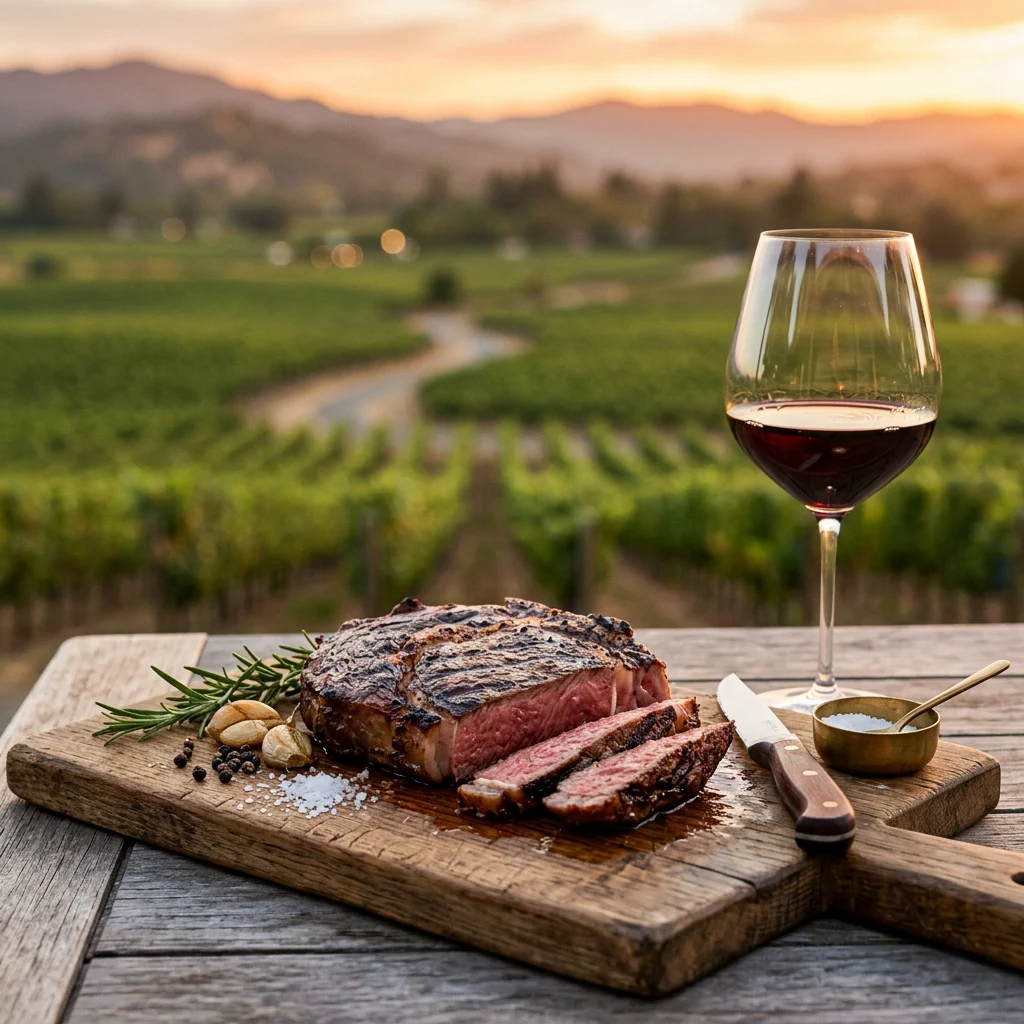
Let me save you some time: if you're grilling a proper ribeye tonight and you're wondering what wine to pour, the answer is Napa Cabernet. Not a maybe, not a 'you could also try,' just—Napa Cab. I got here through roughly ten years of trying every red on the shelf, and the math always comes out the same. Ribeye is the most marbled, most fat-laced, most aggressively beefy steak on the menu. Cabernet Sauvignon is the most tannic, structured, blackberry-forward red on the shelf. They're the M1 chip and macOS—built by different teams but obviously designed to run together.
Tonight I'm breaking down three Napa Cabs I've had multiple times with ribeye, including one aged beauty from Duckhorn that's drinking at absolute peak right now. I'll tell you which is the value play, which is the 'impress your in-laws' play, and which one I'd actually reach for on a Tuesday. And since I'm not a sommelier—I'm a tech founder who fell into wine through way too many trips to Yountville—I'll keep the vocabulary honest. No 'notes of bramble leaf.' Just what the wine tastes like and why it works.
Why Cabernet and Ribeye Are Basically an API Contract
Here's the thing nobody told me for my first three years of drinking red wine with steak: tannin needs fat. That astringent, mouth-coating, slightly-drying sensation you get from a big Cab? That's tannin binding to proteins on your tongue. When you drink a tannic wine solo, it binds to your saliva proteins and you get cottonmouth. Not great. But when you drink that same wine alongside a fatty, protein-rich bite of ribeye, the tannins bind to the beef proteins instead. Suddenly the wine tastes softer, rounder, and the steak tastes less fatty because the tannin is scrubbing your palate clean between bites. It's a biochemistry cheat code.
Ribeye specifically is the play here because of the marbling. Filet mignon is too lean—a $200 Cab overwhelms it. Strip steak is pretty good, but ribeye has that ribbon of intramuscular fat running through it that melts the moment it hits the grill and leaves your mouth coated in beef butter. You need a wine with serious tannic architecture to cut through that. Pinot won't do it. Merlot gets close but lacks the backbone. Cab just works.
The Marbling Math
USDA Prime ribeye is certified at 8–13% intramuscular fat by weight—that's roughly three times what you'd get from a lean cut like tenderloin. That fat is almost entirely oleic and palmitic acid, and when it renders at grill temperatures (around 130°F), it coats every square inch of your palate. You need a wine with enough tannin to scrape it off. That's basically the job description for Napa Cab.
The Three Cabs I Keep Coming Back To
I've tried dozens of Cabs with ribeye over the years. These three are the ones I actually come back to—each at a different price point, each built for a different kind of night. One is a splurge bottle that will make you understand why aged Napa is a thing. One is a mid-career heavy hitter from one of the most storied producers in the valley. And one is the bottle I grab when I'm cooking on a random Wednesday and just want a really good glass of wine without taking out a second mortgage.
1. Duckhorn Three Palms Vineyard Cabernet Sauvignon 2011 — The Aged Beauty
Let's start at the top. Duckhorn's Three Palms Vineyard is one of the most famous single-vineyard sites in Napa—three palm trees standing sentinel at the top of a rocky alluvial fan in the northern part of the valley. The vineyard was originally planted in the 1960s, and the soils are brutal in the best way: rocky, well-drained, and stingy with water. That means low yields, tiny berries, and wines with an intensity most of the valley can only dream about. Three Palms has been a Wine Spectator 'Wine of the Year' (the 2014 vintage famously nabbed #1 in 2017), so we're talking about a legitimately blue-chip site.
The 2011 vintage I keep coming back to is 14 years old as of 2026, and it's sitting at absolute peak right now. This is what people mean when they talk about 'library release' Cab—the wine has shed the youthful aggressive tannins and started developing those tertiary notes you only get with serious bottle age. Price: $80–145 depending on where you find it. That's the splurge tier, no apologies.
What It Tastes Like
On entry you get this mouthwatering burst of cranberry and cassis with surprising acidity for a 14-year-old Napa Cab—the vintage had naturally cool-climate tension. Then the mid-palate broadens into fleshy blue fruit, huckleberry, lavender, cinnamon, clove, and cedar. The finish is long and tobacco-forward. It's sophisticated without being serious, if that makes sense. The kind of wine where you put the glass down and think 'okay, I see it now.'
Why It Crushes Ribeye
The 14 years of bottle age have softened the tannins from 'bullying' to 'firmly guiding.' That's exactly what you want with ribeye fat—enough structure to cut through, not so much that the wine fights the beef for dominance. The huckleberry and clove notes amplify the Maillard crust on the outside of the steak, while the cedar and tobacco pick up the charcoal-grill char. This is a wine for ribeyes you dry-aged yourself or splurged on at Snake River Farms.
“Duckhorn's Three Palms Vineyard bottlings consistently rank among the top 1% of Napa Cabernets, with Wine Spectator famously awarding the 2014 vintage 'Wine of the Year' in 2017. The 2011 doesn't carry that specific trophy, but it's drinking beautifully right now—currently at absolute peak, per the producer's own drinking window, and will hold gracefully through 2035.”
Chad, on why library Duckhorn earns its price tag
The Value Math
Okay, $80–145 is a lot. But here's how I think about it: a dry-aged ribeye at a Michelin-starred steakhouse runs $120. The wine pairing they bring you is usually a $25 glass that retails for $60. You're at $180 for one person for just the steak course. At home, this Duckhorn splits across two generous pours, covers both diners, and you still get change from the equivalent restaurant check. Plus you got to cook the steak yourself, which is half the fun.
2. Stag's Leap Artemis Cabernet Sauvignon 2016 — The Stacked Résumé
Stag's Leap Wine Cellars is the winery that put Napa on the global map—in 1976 their 1973 SLV Cabernet famously won the 'Judgment of Paris' tasting, beating France at its own game and kicking off the California wine revolution. Artemis is their everyday valley-blend Cabernet (as opposed to the single-vineyard SLV and Fay wines, which run $250+), but don't let 'everyday' fool you. This is a seriously pedigreed bottle with serious scores: James Suckling 93, Vinous 91, Wine Spectator 90. At $90–130 it's not cheap, but you're buying into a lineage that actually matters.
The 2016 vintage in Napa was, by most accounts, one of the best of the decade—warm enough for ripeness, cool enough at night to preserve acidity. Artemis ages in French oak and shows beautifully right now, with roughly another nine years of peak drinking ahead of it. This is my 'having my father-in-law over for grill night' bottle.
What It Tastes Like
The nose is pure Napa archetype: blackcurrant, cherry, plum layered with cedar, vanilla, and a hint of dried herbs. There's also a subtle earthy note that wine people call 'forest floor' and I call 'pleasantly mossy.' The palate is full-bodied, rich with dark berries and plum, integrated oak, and a little spice on the back end. Tannins are firm but polished—this is a wine that's been to finishing school. The finish lingers with lingering dark fruit and elegance that doesn't feel performative.
Why It Crushes Ribeye
Artemis has the structure you want for ribeye—firm tannins that slice through the fat with authority, paired with enough fruit depth to complement the Maillard crust rather than compete with it. The dried herbs and cedar notes work beautifully with rosemary-and-garlic compound butter (which you should absolutely be using). It's also explicitly listed as a ribeye pairing in Stag's Leap's own tasting notes—rare to see a winery make a specific steak call, and it means they nailed it on purpose.
“James Suckling's team scored the Artemis 2016 at 93, Vinous at 91, Wine Spectator at 90—when three of the four major scoring houses line up within two points of each other, you're not looking at a vintage outlier. You're looking at a genuinely well-made wine that earned its reputation one consistent vintage at a time.”
Chad, on the Artemis lineage
The Value Math
$90–130 is my 'special occasion, not special-special occasion' sweet spot. You're getting a bottle with real critical consensus, made by a winery with a legitimate claim on Napa history, at a price that's notably less than the Three Palms above. If you want to drink serious Napa Cab without paying for a library release, this is where I'd start every time.
3. Quilt Cabernet Sauvignon — The Weeknight Ringer
Here's my confession: most of my weeknight steak dinners don't get a $100 Cab. I pour Quilt. This is the Jos Phelps family project (Phelps of Insignia fame, which is one of the most respected Napa Cabs ever made), and Quilt is their more accessible $50–75 bottling. It's explicitly built for weeknight grilling—the winery's own food pairing list literally names 'Grilled Ribeye Steak with Rosemary and Garlic' as the hero pairing, and it drinks like a Cab twice its price.
Scores: James Suckling 93, Wine Spectator 91. At $50–75 that's what I'd call a positive ROI bottle—the points-per-dollar math is absurd. If someone blind-poured you Quilt and told you it was $140, you would nod and believe them. This is the one I stock by the case.
What It Tastes Like
Deep ruby color, almost opaque. On the nose: black cherry, blackberry, vanilla, mocha, cedar, a hint of spice and dark chocolate. It's plush and generous and immediately approachable in a way that library Cabs are not. The palate is full-bodied with velvety tannins, balanced acidity, and a rich, layered mouthfeel that just coats your tongue in the best way. Long, elegant finish with refined tannins. Nothing fighting with anything else.
Why It Crushes Ribeye
Quilt is the Cab you pour when you want to enjoy the wine alongside the steak instead of contemplating it. The velvety tannins are already in the zone where they complement fat rather than battle it, so you don't need to spend $100 just to get softness. The mocha and dark chocolate notes pick up beautifully on grilled crust. And honestly, after a long workday, sometimes I don't want a wine that demands attention. I just want a great glass of something while the ribeye rests.
“Quilt scored 93 from James Suckling and 91 from Wine Spectator—both of whom consistently review top-shelf Napa Cabs. For a bottle at the $50–75 price point to land in the same scoring neighborhood as wines 2–3x its cost, someone in the blending room is doing extremely good work. That's Jos Phelps pedigree showing up in an accessible package.”
Chad, on why Quilt is the ringer
The Value Math
This is the bottle I buy on Costco runs (yes, Costco has it, no, that doesn't diminish it). At $50 it's a Tuesday-night steak companion. At $75 it's still ridiculous value. If you only buy one bottle from this article, make it Quilt—you'll drink it more often than the other two combined, and you'll be happy every single time.
Chad's Pick
The Verdict
If money is no object and you want to understand what aged Napa Cab tastes like at its peak, Duckhorn Three Palms 2011 is a revelation and worth every dollar. But the bottle I actually reach for most often, the one I recommend when friends text me asking what to grab for steak night, is the Quilt Cabernet. It's the best points-per-dollar Napa Cab on the shelf right now, it specifically names ribeye in its pairing notes, and it drinks like a wine twice its price. The Artemis is the great in-between bottle when you want pedigree without the library markup. Three bottles, three use cases, zero bad choices.
Here's the tech analogy I promised: the Duckhorn is the fully-specced M3 Max MacBook Pro. The Artemis is the mid-tier M3. The Quilt is the M3 MacBook Air. All three run the same software, all three get you to the same place, but most of the time the Air is the one you actually carry around because the ROI is just obviously right. Build a small case of Quilt. Keep one Artemis for company. Save a Duckhorn for a milestone. That's a wine cellar strategy that survives contact with reality.
Grilling the Ribeye (Because the Steak Matters Too)
Chad's Ribeye Method
I do the reverse sear. Salt the ribeye generously 45 minutes before cooking. Cook in a 225°F oven until the internal temp hits 115°F. Rest for 5 minutes while you crank a cast-iron skillet or grill grate to 'dangerously hot.' Sear 60 seconds per side with butter, garlic, and rosemary basting. Rest 5 more minutes. Total internal temp: 130°F for a perfect medium-rare. The reverse sear gives you an edge-to-edge pink interior with a crust that still crackles. It's also nearly foolproof.
- Salt generously 45 minutes before cooking (dry brine, essentially).
- Cook low-and-slow in a 225°F oven until the internal temp hits 115°F.
- Rest for 5 minutes while you preheat a cast-iron pan or grill to screaming-hot.
- Sear 60 seconds per side with butter + garlic + rosemary basting.
- Target final internal temp: 130°F (medium-rare).
- Rest another 5 minutes before slicing against the grain.
Pouring the Wine (Service Notes)
Serving Temp and Glassware
Napa Cab is routinely served too warm. Pour at 60–65°F, not 70°F+ room temp. In practice that means 20 minutes in a wine fridge before service, or 10 minutes in your kitchen fridge if you don't have one. Decant the Duckhorn and Artemis for 30 minutes to let them open up—especially the Duckhorn, which will throw sediment. The Quilt is happy straight from the bottle. Bordeaux glasses (the taller, narrower ones) focus the aromatics. Skip the thin-rim 'universal' glasses; they're lying to you.
- Serving temperature: 60–65°F (fridge for 10–20 minutes if room is warm)
- Decant Duckhorn and Artemis 30 minutes before serving
- Stand older bottles upright the day before (the Three Palms will have sediment)
- Use Bordeaux glasses—wider bowl, tall chimney
- Pour small: 4–5 oz first pour, refill after the first few bites
Building the Full Steak Dinner
I won't tell you how to run your own kitchen, but a few things matter. First, don't overcomplicate the plate. Ribeye and Cab don't need a lot of supporting cast. Second, whatever sides you serve should either echo the wine (roasted mushrooms, something with rosemary) or provide contrast (a sharp salad with vinaigrette, charred broccolini with lemon). Third, keep dessert simple and dark—if anything, a wedge of aged cheddar and a handful of walnuts is better than any chocolate cake you could order.
Sides That Actually Work
- Roasted cremini or porcini mushrooms with garlic, thyme, and a splash of the wine you're drinking
- Charred broccolini with lemon and chili flakes (acid and bitterness for contrast)
- Crispy smashed potatoes with rosemary salt
- A small arugula salad with shaved Parmesan and balsamic (just enough to reset the palate)
- Grilled asparagus with lemon zest
- Nothing creamy—skip the mashed potato and the Alfredo-adjacent sides. They fight the wine.
The Hidden Trick: Reverse-Seared Steak + Decanted Cab
Here's the move that took me years to figure out. The reverse-sear method gives you this beautiful wide window of 'done-ness'—once the steak hits 115°F in the oven, you can rest it for 5 or 15 minutes before searing without losing anything. Use that window to decant your wine. Pour the Cab into a decanter the moment the steak goes into the oven, and it'll have a full 90 minutes to breathe by the time you're sitting down. Young Cabs benefit from this more than you'd think. The tannins integrate, the fruit opens up, and the wine meets the steak already awake. It's the single most impactful piece of wine service I've learned. Free, takes zero effort, makes everything better.
The Judgment of Paris
The Stag's Leap Wine Cellars 1973 SLV Cabernet beat five first-growth Bordeaux in the 1976 Paris tasting, judged blind by a panel of French wine professionals who were stunned. That one afternoon—May 24th, 1976—is the moment Napa Valley's global reputation was cemented. The Artemis above isn't the SLV bottling that won the Judgment, but it comes from the same winery, the same vineyards, and the same winemaking philosophy. You're drinking Napa wine history, and it happens to be really good with ribeye.